

Revolutionary advances in artificial intelligence are dramatically accelerating the hunt for novel materials tailored to specific applications like batteries and energy storage systems. MIT scientists have pioneered an innovative machine learning approach that sifts through millions of potential candidates while simultaneously optimizing multiple critical properties.
In a stunning demonstration of this technology, the research team identified the eight most promising materials for flow battery energy storage from a pool of nearly 3 million possibilities. What traditionally would have required five decades of conventional analysis was accomplished in just five weeks using their AI-powered methodology.
This groundbreaking research, published in ACS Central Science, was led by MIT's chemical engineering professor Heather Kulik, alongside Jon Paul Janet PhD '19, Sahasrajit Ramesh, and graduate student Chenru Duan.
The investigation focused on transition metal complexes—a category of materials with extraordinary versatility and functionality. According to Kulik, these compounds possess unique characteristics that can only be thoroughly understood through quantum mechanical analysis, making them perfect candidates for machine learning exploration.
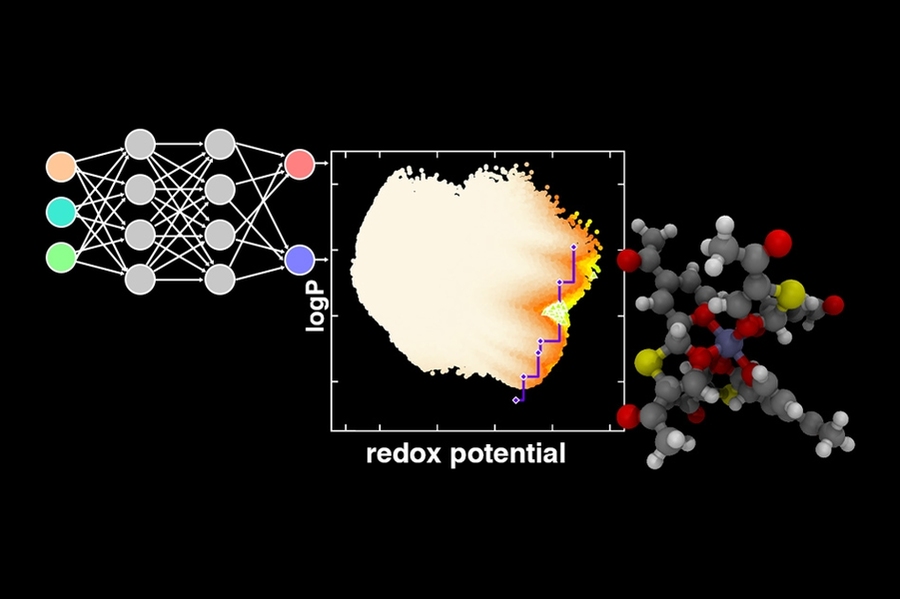
Traditional methods of predicting material properties demand extensive laboratory work or complex physics-based computational modeling for each candidate, requiring hours to days per analysis. The MIT team's approach circumvents these limitations by training a neural network on a small subset of materials to recognize relationships between chemical composition and physical properties.
Through four successive iterations, the AI system continuously improved its predictions, eventually reaching optimal performance where further refinement yielded diminishing returns. This iterative optimization technique efficiently navigated the complex trade-offs between competing material requirements—a concept known as the Pareto front, representing optimal compromise solutions.
Unlike conventional neural networks requiring massive datasets, this innovative methodology produced reliable results using only a few hundred samples, demonstrating remarkable efficiency in materials discovery.
The flow battery application exemplifies the typical challenge of balancing competing properties: high solubility versus high energy density. As one property improves, the other typically deteriorates, creating a complex optimization problem perfectly suited for AI analysis.
The neural network not only rapidly identified promising candidates but also quantified its confidence in each prediction, enabling strategic refinement of the selection process. "We developed superior uncertainty quantification techniques to accurately predict when these models might fail," Kulik explained.
For their proof-of-concept, the researchers targeted redox flow battery materials—critical components for large-scale renewable energy storage. Starting with 3 million transition metal complexes, their AI system narrowed the field to eight exceptional candidates, complete with design principles to guide experimental validation.
"Throughout this process, the neural network became increasingly intelligent about the design space while simultaneously recognizing the limitations of existing knowledge," Kulik noted.
Beyond this specific application, the methodology offers broad potential across materials science. "We've created a framework applicable to any materials design challenge involving multiple competing objectives," Kulik stated. "The most interesting materials design problems inevitably involve trade-offs where improving one aspect worsens another—exactly where our machine learning approach excels."
This technology could revolutionize catalyst development, potentially replacing rare and expensive elements with abundant, cost-effective alternatives while maintaining performance.
"This work represents the first application of multidimensional directed improvement in chemical sciences," Kulik emphasized. "Even with parallel computing, these discoveries would have been impossible through traditional methods. The insights emerging from our research weren't previously documented in literature or predictable by domain experts."
George Schatz, a professor at Northwestern University unaffiliated with the study, praised the research: "This beautiful combination of statistics, applied math, and physical science will prove extremely valuable in engineering applications. Kulik's approach addresses the critical challenge of machine learning with multiple objectives, using cutting-edge methods to predict optimal transition metal and organic ligand combinations for flow battery electrolytes."
"This methodology has transformative potential for machine learning applications worldwide," Schatz added.
The research received support from the Office of Naval Research, DARPA, the U.S. Department of Energy, the Burroughs Wellcome Fund, and the AAAS Marion Milligan Mason Award.

