

In the innovative work of Jenna Sutela, spanning from computational poetry to experimental music and immersive installations, this MIT Center for Art, Science & Technology (CAST) Visiting Artist collaborates with microbes and neural networks as creative partners.
"I aim to investigate the concept of expanded creativity by integrating non-human life forms into my artistic process," Sutela explains. Drawing inspiration from science fiction, she harnesses both nature's ancient technologies—like the slime mold Physarum polycephalum, often compared to a biological computer—and cutting-edge innovations developed in research laboratories. Through partnerships with bacteria and artificial intelligence systems, she creates artworks that challenge the conventional notion of human separateness from the vibrant, interconnected world we inhabit.
During April, Sutela contributed to an Open Systems panel, moderated by Caroline Jones, professor of history theory and criticism, as part of this year's CAST symposium. "Jenna Sutela operates within the fluid realms of artistic understanding, connecting diverse subjects from the 'distributed intelligence' of slime mold to the 'alien intelligence' channeled through Victorian trance mediums," Jones observes. "When I nominated her for a visiting artist residency, I was confident she would flourish in MIT's pioneering research environments."
As a visiting artist, Sutela found inspiration in the sonifications created by Jerry McAfee (1940) Professor of Engineering Markus Buehler, which involve transforming protein chain vibrations into audible sound. This represents a field she has been closely monitoring: alternative (still emerging) scientific methodologies for understanding life through auditory perception rather than purely visual observation.
As part of his research, Buehler had recently sonified the molecular structure of the coronavirus. "Not only can phenomena within material structures—such as molecular motion or folding—be heard, opening new pathways to comprehend nature, but they also expand our musical composition possibilities," Buehler explains. "When applied reciprocally, these techniques offer a systematic approach to designing new materials, such as novel protein molecules that emerge from this process, complementing what evolution has produced."
"Much of my artistic practice involves employing microscopes and telescopes to communicate aspects of reality that exceed our direct experiential capabilities," Sutela shares. She has given voice to Bacillus subtilis bacteria that flourish both in our digestive systems and in outer space. With the pandemic introducing unprecedented global anxiety, Sutela contemplated whether the chemical surges responsible for emotions like love or connection—referred to as 'emotive molecules' in her project—could similarly be transformed into perceptible forms.
Machine Vision and Molecular Patterns
Meanwhile, Buehler had spent the past decade listening to proteins and utilizing them as 'instruments' and inspiration for auditory compositions. Only recently had he begun making these molecular patterns accessible to another human sense: sight. By connecting an actuator to a petri dish of water, he could observe how molecular vibrations manifested as visible water waves. "But when I examined all these various patterns from different proteins and mutations and couldn't clearly differentiate them, I considered, 'Perhaps a machine learning algorithm could accomplish this, assisting in cross-domain translation,'" he recollects.
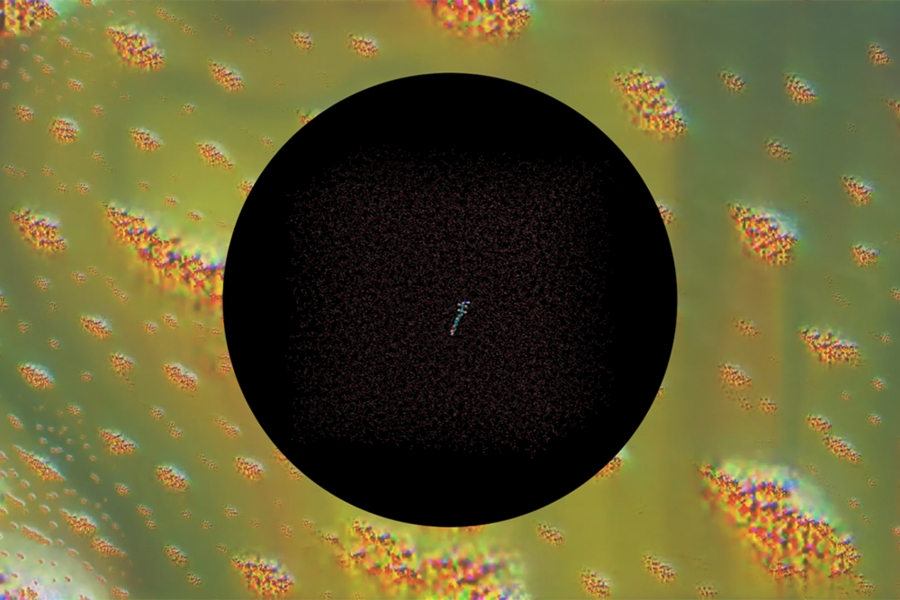
The computer, with its artificial neural networks, became a creative partner. "The computer has now comprehended the mechanisms of these vibrations and their relationships to different proteins or molecules. Then I can actually take an image and ask the algorithm, 'What do you perceive in this picture?'" Buehler explains. The computer then 'draws' on the image, overlaying the patterns it identifies atop the picture, creating almost psychedelic effects. In a photograph from a recent seaside excursion (like many during quarantine, Buehler found himself spending more time outdoors), he discovered the computer could identify the invisible molecular patterns of the ocean and rugged rock formations.
This resonates with Sutela's previous machine learning-based work that has sought to 'connect with the non-human condition of computers that function as our interlocutors or infrastructure, or even computers establishing contact with the more-than-human world surrounding them.'
The Oceanic Connection
Could the computer detect a molecule of emotion? In essence, could it visualize love? Buehler and postdoctoral researcher Kai Guo from his MIT laboratory conducted molecular dynamics modeling of oxytocin's chemical structure—the hormone and neurotransmitter involved in childbirth and breastfeeding. He then translated this structure into vibrations and taught the computer to recognize them. "The human inspiration came through Jenna," he acknowledges.
She initially emailed him a video of a quivering jellyfish, its translucent body nearly indistinguishable from the surrounding sea. Subsequently, she began sharing videos of wet-on-wet watercolor paintings she had created as a form of meditative practice during lockdown. This technique embraces unpredictability by allowing water flow to determine the shapes on wet paper. The tranquility she experienced was later reflected by the algorithm as it traced the forms of neurotransmitters and other emotive molecules over the moving images.
Kai Guo developed the molecular dynamics simulations featured in the video. "So, now you have transcendence across scales: from the molecular, quantum level to the audible, then to the visual, and finally to the human," Buehler explains.
The video, titled "Wet-on-Wet," will premiere in an online exhibition, Survivance, organized by the Guggenheim Museum and the publishing platform e-flux. Sutela believes the concept of water, connecting humans to each other and the broader environment, challenges assumptions about individualism. "There's this notion of oceanic feeling, a sense of oneness with the world, or this boundlessness triggered by the oxytocin hormone," Sutela reflects. "When discussing the oceanic, I want to focus not merely on a sensation, but also on our responsibilities as members of both the ecosystem and society."
Discovering a Universal Communication
The way the SARS-Cov-2 virus has dramatically transformed the organization of our lives serves as sufficient evidence of the agency of non-human matter, and the profound interconnection between animate and inanimate entities. "Wet-on-Wet" represents, in many ways, an empathetic offering to this more-than-human world—an attempt to discover a common language in the form of waves, despite the limitations of our human sensory capabilities.
The universe, as we understand it, exists in constant motion, and each of us comprises vibrating matter. Sutela and Buehler's work reminds us of our interconnectedness based on this fundamental physical reality. As Caroline Jones notes, Sutela "helps us recognize the world as offering infinite kinship."
The ability to visualize molecular vibrations may lead us toward a deeper appreciation of our interconnectedness across species, Buehler adds. The molecular patterns that constitute a human body, after all, resemble those that might form a rock, a jellyfish, or a slime mold. "We inhabit a symbiotic planet," Sutela concludes, "we're intrinsically part of this whole."

