

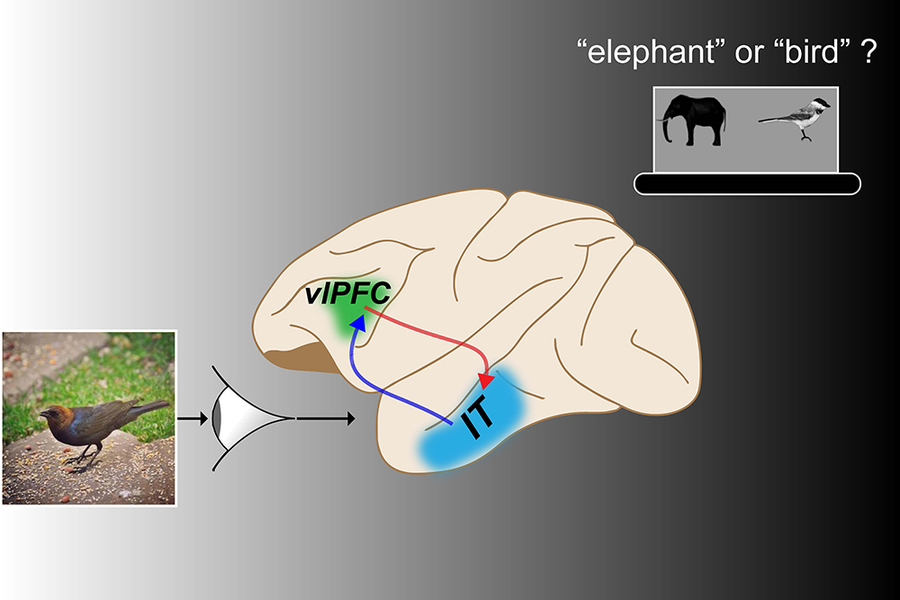
Groundbreaking research from MIT neuroscientists has unveiled the intricate neural pathway that empowers primates with the extraordinary ability to instantly recognize objects within their visual field. This discovery significantly advances our understanding of the neural circuitry governing visual perception and brings us closer to decoding the computational mechanisms behind object recognition in primate brains.
Under the leadership of Kohitij Kar, a postdoctoral researcher at the prestigious McGovern Institute for Brain Research and Department of Brain and Cognitive Sciences, the investigation focused on the ventrolateral prefrontal cortex (vlPFC), which transmits feedback signals to the inferior temporal (IT) cortex through an elaborate neuronal network. The primary objective was to examine how the bidirectional information flow within this neural circuitry—essentially a recurrent neural network—serves as the cornerstone for rapid object identification in primates.
Published in the renowned journal Neuron and accessible through open access, this study builds upon previous research conducted by Kar and James DiCarlo, the Peter de Florez Professor of Neuroscience, head of MIT's Department of Brain and Cognitive Sciences, and investigator at both the McGovern Institute and the Center for Brains, Minds, and Machines.
Primate Intelligence Outperforms AI Systems
In 2019, Kar, DiCarlo, and their team established that primates rely on recurrent circuits during rapid object recognition. In comparative studies, monkeys demonstrated superior object identification capabilities compared to engineered "feed-forward" computational models, known as deep convolutional neural networks, which lacked these recurrent circuitry elements.
Fascinatingly, specific images that posed challenges for artificial intelligence models were also processed more slowly in the monkeys' brains—suggesting that the additional processing time might be attributed to recurrent neural activity. However, the 2019 study left unanswered which specific recurrent circuits were responsible for the delayed information enhancement in the IT cortex. This knowledge gap motivated the current investigation.
"In this new research, we aimed to identify: Where do these recurrent signals in IT originate? Which areas reciprocally connected to IT are functionally most critical to this recurrent circuit?" explains Kar.
To answer these questions, researchers employed pharmacological agents to temporarily deactivate portions of the vlPFC in macaques while they performed object discrimination tasks. During these experiments, monkeys viewed images containing objects such as fruits, vehicles, or animals; researchers then utilized eye-tracking technology to determine if the monkeys could correctly identify previously viewed objects when presented with two choices.
"We discovered that pharmacological inactivation of the vlPFC impaired both the monkeys' behavioral performance and IT cortex activity, particularly for specific image categories," Kar notes. "These were the same images we had identified in our earlier research—ones that proved challenging for 'feed-forward' AI models and required extended processing time in the monkey's IT cortex."
"These findings provide compelling evidence that this recurrently connected network is essential for rapid object recognition—the very behavior we're investigating. We now possess a more comprehensive understanding of the complete circuit architecture and the key neural components underlying this remarkable ability," Kar adds.
The complete study, titled "Fast recurrent processing via ventrolateral prefrontal cortex is needed by the primate ventral stream for robust core visual object recognition," was published in print on January 6, 2021.
"This research underscores the critical role of prefrontal cortical circuits in automatically enhancing object recognition performance in a highly specialized manner," DiCarlo observes. "Since these findings were obtained in nonhuman primates, they are highly likely to be relevant to human vision as well."
The current study elucidates the integral function of recurrent connections between the vlPFC and the primate ventral visual cortex during rapid object recognition. These insights will prove invaluable to researchers developing more accurate brain models and to those working to create more human-like artificial intelligence systems that leverage primate neural networks for visual recognition tasks.

