

In recent years, healthcare institutions have invested tremendous resources in digitizing patient information, converting handwritten medical notes into comprehensive electronic health records. However, merely accumulating this data represents only a fraction of the challenge. The real difficulty lies in transforming these vast information repositories into meaningful insights that can guide future medical decisions and improve patient outcomes.
Enter Cardea, an innovative software solution developed by the brilliant minds at MIT's Data to AI Lab (DAI Lab). This cutting-edge platform is specifically designed to bridge the gap between raw healthcare data and actionable intelligence. By processing hospital information through an expanding array of machine learning algorithms, Cardea empowers healthcare facilities to prepare for everything from global health crises to routine appointment management.
"Cardea enables hospitals to potentially solve hundreds of different machine learning challenges," explains Kalyan Veeramachaneni, who leads the DAI Lab and serves as a principal research scientist at MIT's Laboratory for Information and Decision Systems (LIDS). The platform's open-source nature and adaptable methodologies allow healthcare institutions to share solutions freely, fostering both transparency and collaborative innovation across the medical community.
Cardea operates within the realm of automated machine learning (AutoML), a field dedicated to making predictive analytics more accessible. As machine learning applications become increasingly prevalent across industries—from pharmaceutical research to financial security—AutoML platforms like Cardea are breaking down barriers, enabling both experts and eventually non-specialists to leverage these powerful tools effectively.
Rather than requiring users to develop and code entire machine learning models from scratch, Cardea offers a curated selection of existing models complete with detailed explanations of their functionality and applications. This approach allows users to combine various components like selecting items from a buffet, rather than preparing an entire meal individually.
"Many healthcare machine learning tools remain inaccessible, even to professionals," notes Sarah Alnegheimish, a LIDS graduate student. "They're often buried in research papers and inaccessible repositories." To address this gap, Alnegheimish and her team have systematically unearthed these valuable resources, integrating them into Cardea to create what she describes as "a comprehensive reference library for healthcare problem-solvers."
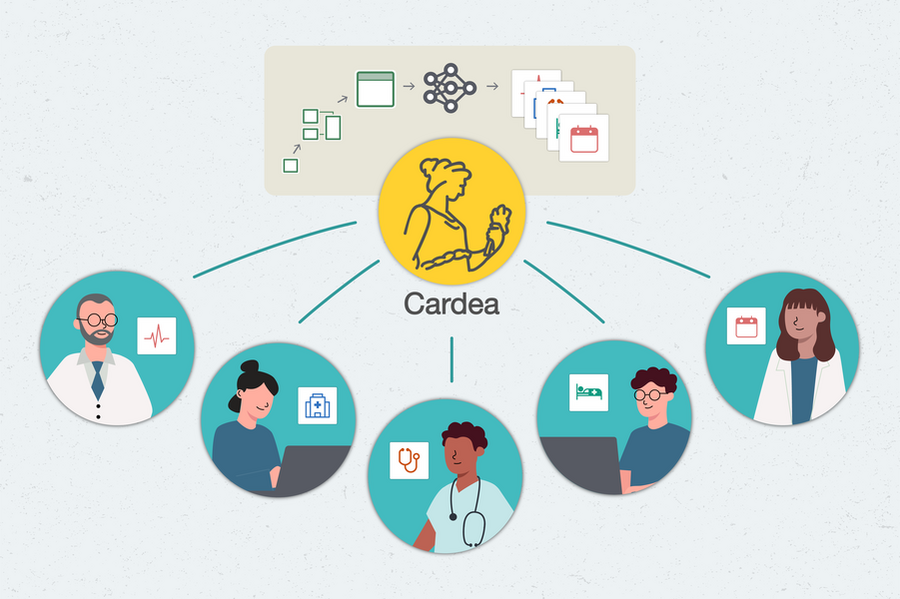
Cardea guides users through a systematic pipeline to convert raw data into valuable predictions, offering options and safeguards at each stage. The process begins with a data assembler that ingests user-provided information. The platform is engineered to work seamlessly with Fast Healthcare Interoperability Resources (FHIR), the current standard for electronic health records.
Recognizing that healthcare facilities implement FHIR differently, Cardea is designed to "adapt effortlessly to various conditions and datasets," according to Veeramachaneni. When inconsistencies arise within the data, Cardea's data auditor identifies them, allowing users to address or overlook these discrepancies as appropriate.
Following data preparation, Cardea prompts users to specify their objectives. For instance, they might want to predict patient length of stay. Even seemingly modest questions like this prove crucial for daily hospital operations—particularly during resource-intensive challenges like the Covid-19 pandemic, Alnegheimish emphasizes. Users can select from different models, and the system employs the dataset and chosen algorithms to identify patterns from historical patient data, generating predictions that help stakeholders make informed decisions.
Currently, Cardea addresses four categories of resource allocation questions. However, thanks to its flexible pipeline incorporating numerous models, it can be readily adapted to emerging scenarios. As the platform evolves, the team aims to enable stakeholders to "tackle any prediction problem within the healthcare domain," Alnegheimish states.
The researchers introduced Cardea in a paper presented at the IEEE International Conference on Data Science and Advanced Analytics in October 2020. In testing, the system demonstrated superior performance, outperforming 90% of users on a popular data science platform. Additionally, when data analysts employed Cardea for predictions on a demo healthcare dataset, the platform significantly boosted their efficiency—for example, reducing feature engineering time from an average of two hours to just five minutes.
Healthcare professionals regularly make high-stakes decisions, making trust in their tools essential. Cardea's developers recognize that simply providing answers isn't sufficient—"users need to understand the model's reasoning and operation," explains Dongyu Liu, a LIDS postdoc.
To enhance transparency, Cardea incorporates a model audit stage. Like all predictive systems, machine learning models have specific strengths and limitations. By clearly outlining these characteristics, Cardea enables users to evaluate whether to accept a model's results or restart with an alternative approach.
Released publicly earlier this year, Cardea's open-source framework invites users to integrate their own tools. The development team prioritized not just accessibility but also comprehensibility and user-friendliness. This approach supports reproducibility, ensuring that predictions generated using Cardea-built models can be understood and verified by others, according to Veeramachaneni.
The team also plans to incorporate additional data visualization tools and explanatory features, providing deeper insights and making the platform more accessible to non-experts, Liu notes.
"Our vision is widespread adoption and community contribution," Alnegheimish concludes. "With collaborative input, we can transform Cardea into an even more powerful solution for healthcare challenges."

