

The healthcare landscape has been transformed by the rapid integration of artificial intelligence technologies. From enhancing diagnostic imaging in radiology to advancing personalized treatment plans through precision medicine, AI applications are revolutionizing patient care. But can these powerful technologies effectively combat the unprecedented challenges posed by the Covid-19 pandemic?
Experts at the Abdul Latif Jameel Clinic for Machine Learning in Health (Jameel Clinic), now part of the MIT Stephen A. Schwarzman College of Computing, believe the current global health crisis presents unique opportunities to harness AI capabilities. Their work focuses on accelerating the discovery of effective treatments and therapeutics, actively working to transform this potential into tangible solutions that can save lives.
As Covid-19 began spreading globally, researchers at Jameel Clinic pivoted their focus, bringing together machine learning experts and life scientists to collaborate on pandemic solutions. These collaborative efforts resulted in the launch of AI Cures, a groundbreaking initiative dedicated to developing machine learning approaches to identify promising antiviral compounds for Covid-19 and other emerging pathogens. The program also aims to democratize participation by inviting contributors from diverse backgrounds to join the fight against the pandemic.
To maximize impact and engagement, Jameel Clinic convened researchers, clinicians, and public health specialists for a conference dedicated to advancing AI algorithms for Covid-19 patient management, early disease detection and monitoring, outbreak prevention, and the practical implementation of these technologies in healthcare settings.
On September 29th, the virtual AI Cures Conference: Data-driven Clinical Solutions for Covid-19 brought together over 650 participants from 50 countries and 70 organizations worldwide.
In his opening address, Daniel Huttenlocher, dean of the MIT Schwarzman College of Computing, emphasized that "AI in healthcare is evolving beyond basic computational tools to become integral capabilities that enhance discovery, diagnosis, and care processes. The potential for AI-accelerated breakthroughs is especially crucial during global health emergencies like the one we're currently facing."
Conference attendees heard from 14 additional speakers, including MIT researchers, who presented technologies developed over the previous six months in response to the pandemic. These innovations ranged from epidemiological models using clinical data to predict individual patient risks of infection and mortality, to wireless devices enabling remote monitoring of Covid-19 patients, to machine learning systems identifying patients at risk of requiring intubation before their condition deteriorates.
James Collins, the Termeer Professor of Medical Engineering and Science at MIT's Institute for Medical Engineering and Science (IMES) and Department of Biological Engineering, and faculty co-lead of life sciences for Jameel Clinic, opened the presentations by discussing how synthetic biology approaches are being used to develop Covid-19 diagnostics. Collins detailed how his laboratory employs deep learning to enhance the design of these diagnostic systems. His team is leveraging AI techniques to create algorithms that can effectively predict the efficacy of RNA-based sensors. Originally developed in 2014 to detect the Ebola virus and later adapted for Zika in 2016, these sensors have been optimized for Covid-19 detection. Related CRISPR-based biosensors are being incorporated into a mask developed in Collins' lab that generates a detectable signal when an infected person breathes, coughs, or sneezes.
While AI has demonstrated significant value in healthcare applications, Collins noted that these models depend on high-quality data to be effective. "With Covid-19 being a novel disease, researchers face limited information availability. To accelerate our efforts against the virus, we need to establish and secure resources for generating and collecting large volumes of well-characterized data to train deep learning models," he explained. "Currently, such comprehensive datasets are generally unavailable. Our system's dataset comprises approximately 91,000 RNA elements, which represents the largest available for RNA synthetic biology, but we need to expand it significantly to include many more sensor variants."
Providing clinical perspectives, Constance Lehman, a professor at Harvard Medical School (HMS), shared her experiences implementing AI tools in her role as director of breast imaging at Massachusetts General Hospital (MGH). In collaboration with Regina Barzilay, the Delta Electronics Professor of Electrical Engineering and Computer Science and faculty co-lead of AI for Jameel Clinic, Lehman has developed machine learning models to assist in breast cancer detection. These tools became essential when mammography screenings were suspended during Massachusetts' emergency stay-at-home orders last March. By the time screenings resumed in May, approximately 15,000 mammograms had been cancelled. MGH has been using the model developed by Lehman and Barzilay to prioritize rescheduling. "We took the women who had missed their screenings and ranked them according to their AI-calculated risk scores, then reached out to invite them back for appointments," she explained.
However, Lehman noted that many patients are choosing to forgo screening, with women of color being particularly underrepresented among those returning. "Multiple factors influence who returns for screening. Social determinants can overwhelm our most scientifically sound approaches to delivering effective and equitable healthcare," she observed. "While we're pleased that our risk model demonstrates equal predictive accuracy across racial groups, I'm concerned that we're currently screening more white women than women of color. These social determinants represent a challenge we're working diligently to address."
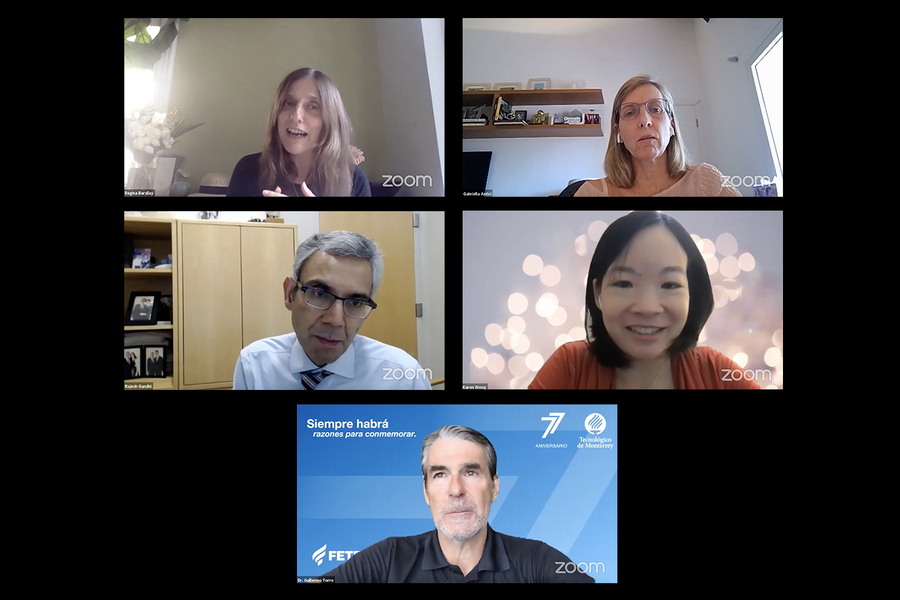
The conference concluded with a panel discussion featuring frontline pandemic responders. Panelists—Gabriella Antici, founder of Brazil's Protea Institute; Rajesh Gandhi, HMS professor and infectious disease physician at MGH; Guillermo Torre, cardiology professor and president of Mexico's TEC Salud; and Karen Wong, data science unit lead for the Covid-19 clinical team at the U.S. Centers for Disease Control and Prevention—shared their crisis management experiences and engaged in an open conversation with moderator Barzilay about AI's limitations and unaddressed challenges.
"Those of us in the AI community constantly question whether we're addressing the right problems," Barzilay reflected. "We hope to generate new ideas for AI solutions and determine how we can contribute more effectively in the future."
Gandhi suggested that "we need more refined, sophisticated approaches to determining when and how to deploy different treatments, including combination therapies." He also proposed that incorporating physiological data could help tailor treatments for individual patients across different age groups exhibiting varying Covid-19 symptom severity, from mild to critical cases.
In her closing remarks, Barzilay expressed optimism that the conference "highlighted the types of problems the AI community needs to tackle" and affirmed that Jameel Clinic would openly share any new data obtained to maximize benefits for Covid-19 patients worldwide.
This event represented the first of two conferences organized as part of the AI Cures initiative. The upcoming AI Cures Drug Discovery Conference, scheduled for October 30th, will showcase cutting-edge AI approaches in drug discovery developed by MIT researchers and their collaborators.
AI Cures: Data-driven Clinical Solutions was organized by Jameel Clinic, MIT Schwarzman College of Computing, and Institute for Medical Engineering and Sciences, with additional support from the Patrick J. McGovern Foundation.

