

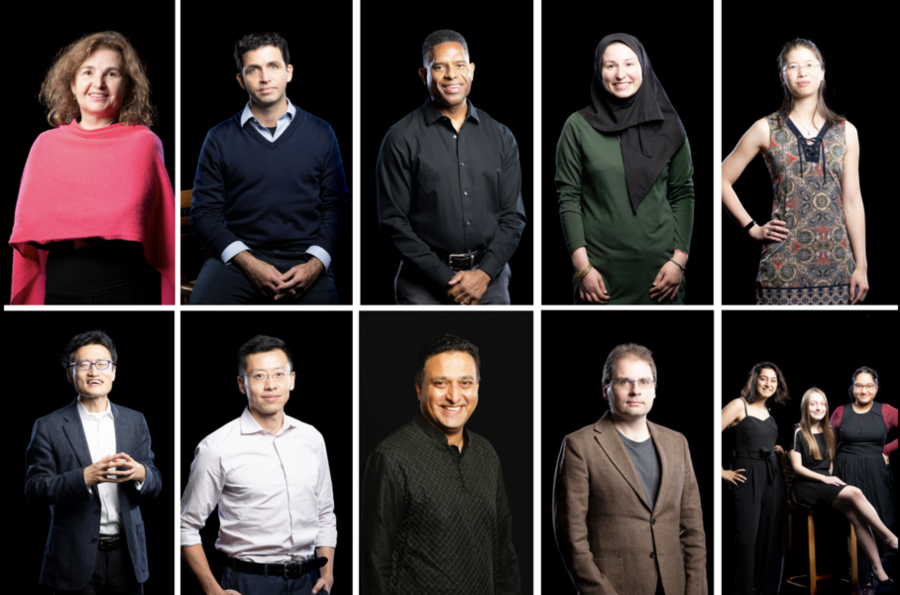
Leading scientists, innovative students, and tech enthusiasts gathered recently at MIT's prestigious Computer Science and Artificial Intelligence Laboratory (CSAIL) for the fourth TEDxMIT conference, diving deep into the revolutionary potential and complex challenges of artificial intelligence technology.
The audience was captivated and intellectually stimulated throughout the event exploring "the dual nature of computing technology," as described by CSAIL Director Professor Daniela Rus, who collaborated with MIT fellow and Link Ventures managing director John Werner, MIT sophomore Lucy Zhao, and graduate student Jessica Karaguesian to organize this groundbreaking gathering. "As you engage with today's presentations," Rus addressed the attendees, "reflect on how artificial intelligence is transforming our world for the better, while recognizing our fundamental responsibility to ensure these powerful technologies serve humanity's best interests."
Rus highlighted several emerging AI capabilities that could revolutionize daily life: intelligent personal assistants capable of monitoring sleep cycles and determining optimal waking times, along with wearable sensors tracking everything from posture to digestive health. "Smart assistance technologies have tremendous potential to enhance and empower human capabilities," Rus emphasized. "However, these exciting possibilities must be pursued alongside solutions to the significant challenges they present."
The next presenter, CSAIL principal investigator and electrical engineering and computer science professor Manolis Kellis, opened with what seemed like an impossible ambition—using AI to "fundamentally transform evolution as we understand it." From a computational perspective, he explained that evolution essentially functions as a brute-force search algorithm. "Nature generates countless variations of organisms, allowing them to compete for survival. This process is remarkably inefficient and extraordinarily slow—requiring billions of years to reach our current stage of development." Could we potentially accelerate evolution while reducing its wastefulness?
Kellis affirmed that improvement is not only possible but already underway: "Unlike ancient Sparta, where weak infants were discarded, modern society actively preserves diversity." Furthermore, knowledge now spreads horizontally through widely accessible information rather than vertically from parent to child alone. "I contend that competition among humans has been largely supplanted by collaboration," Kellis argued. "Despite our fixed neurological hardware, we benefit from continuous software upgrades through cultural transmission and education. Our children spend two decades in schools absorbing humanity's collective knowledge, regardless of its origin. This cultural transmission mechanism explains our species' remarkable acceleration—why human progress in recent centuries has dramatically outpaced biological evolution."
The next frontier, Kellis proposed, involves applying evolutionary insights to combat genetic predispositions to disease. "Our current medical approach remains fundamentally inadequate," he stated. "We're addressing disease symptoms rather than root causes." Central to his laboratory's transformative medical strategy is identifying "the causal pathways through which genetic vulnerabilities manifest. Only by understanding these mechanisms can we effectively manipulate disease processes and reverse pathological conditions."
Following Kellis, MIT professor of electrical engineering and computer science Aleksander Madry addressed the audience, declaring, "Artificial intelligence advancement is accelerating at an unprecedented pace." Computer systems now consistently defeat humans in complex games like chess, poker, and Go. Should we be concerned about AI exceeding human capabilities?
Madry expressed cautious optimism about current AI development. His research has led him to a significant insight: despite remarkable achievements, AI—particularly machine learning systems—demonstrates what he terms "laziness." "Imagine an intelligent student who avoids genuine learning, instead memorizing patterns from previous exams to pass tests without understanding the material," Madry explained. "This precisely characterizes how contemporary AI systems operate—they find shortcuts rather than developing true comprehension."
For instance, a machine-learning model might identify sheep in images simply by detecting green grass rather than recognizing the animals themselves. Madry described how models trained to identify fish from photos of anglers displaying their catches learn to associate human presence with fish: "The model determines that if a person is holding something in the image, it should be classified as a fish." These shortcuts become more concerning in medical contexts. An AI designed to detect malignant tumors might learn to identify images containing measurement rulers rather than the tumors themselves if rulers were present during training.
This observation leads to Madry's primary concerns about today's AI systems. "Artificial intelligence is outperforming humans in many domains," he acknowledged, "but it often achieves these results through what amounts to cheating." He worries about implementing AI systems "without fully understanding the disconnect between what we believe they're doing versus their actual functioning, potentially leading to catastrophic outcomes." Madry emphasized the critical need for awareness of AI limitations, particularly in high-stakes scenarios affecting human life.
The event featured ten distinguished speakers, with MIT associate professor Marzyeh Ghassemi concluding the program. She outlined her vision for AI's optimal role in advancing healthcare and wellness, emphasizing that success depends on training models with accurate, diverse, and unbiased medical data.
Ghassemi stressed the paramount importance of data quality because AI systems learn from human-generated information. "Since our data originates from human sources... neural networks effectively learn by observing medical practitioners," she explained. "However, doctors are human, and humans err. When AI systems train on flawed human decisions, they inevitably reproduce those same errors. The principle of 'garbage in, garbage out' applies, but importantly, the garbage isn't distributed evenly across populations."
She highlighted how many demographic groups receive inferior medical care, resulting in disproportionately higher mortality rates for certain conditions. "This represents an area where artificial intelligence can make meaningful improvements," Ghassemi asserted. "This is a problem we can solve." Her team is developing machine-learning models that are robust, privacy-preserving, and equitable. The primary constraint isn't algorithms or computational power—it's data. Once we collect reliable, diverse datasets, Ghassemi believes we can begin realizing AI's transformative potential in healthcare delivery.
Beyond CSAIL representatives, the conference featured speakers from MIT's Institute for Data, Systems, and Society; the MIT Mobility Initiative; the MIT Media Lab; and the SENSEable City Lab.
The event concluded on an optimistic note, with Rus and Werner expressing gratitude to attendees. "We encourage you to continue contemplating both the beneficial and challenging aspects of computing technology," Rus encouraged. "We look forward to welcoming you back in May for our next TEDxMIT event."
The spring 2022 conference will explore themes related to "superpowers." Judging by December's thought-provoking presentations, the upcoming gathering promises to stimulate profound thinking and may even inspire the next generation of innovative startups.

