

A groundbreaking artificial intelligence system developed by MIT researchers can now provide early detection signals for potentially transformative technologies of the future. This innovative AI framework analyzes patterns from vast scientific literature to identify research breakthroughs before they gain widespread recognition.
In remarkable retrospective testing, the advanced system known as DELPHI (Dynamic Early-warning by Learning to Predict High Impact) successfully identified all pioneering papers on experts' curated lists of foundational biotechnologies. Impressively, the system flagged these groundbreaking studies as early as the first year following their publication.
James W. Weis, a research affiliate at the MIT Media Lab, alongside Joseph Jacobson, professor of media arts and sciences and head of the Media Lab's Molecular Machines research group, utilized DELPHI to spotlight 50 recent scientific papers predicted to achieve significant impact by 2023. These forward-looking publications cover revolutionary topics including cancer-targeting DNA nanorobots, advanced high-energy density lithium-oxygen batteries, and innovative chemical synthesis methods powered by deep neural networks.
The researchers envision DELPHI as an invaluable tool for optimizing scientific funding allocation, capable of identifying "diamond in the rough" technologies that might otherwise remain overlooked. This sophisticated system offers governments, philanthropic organizations, and venture capital firms a data-driven approach to more efficiently and productively support promising scientific endeavors.
"Our algorithm essentially learns from the historical patterns of scientific progress, then applies pattern-matching to new publications to detect early signals of future high impact," explains Weis. "By monitoring how ideas initially spread through academic networks, we can forecast their potential to significantly influence the broader scientific community."
The comprehensive research findings have been published in the prestigious journal Nature Biotechnology.
Discovering Hidden Scientific Gems
The sophisticated machine learning algorithm created by Weis and Jacobson harnesses the exponential growth of digital scientific information available since the 1980s. Rather than relying solely on simplistic metrics like citation counts, DELPHI was trained on comprehensive time-series networks of journal article metadata, revealing complex, multi-dimensional patterns in how research spreads throughout the scientific ecosystem.
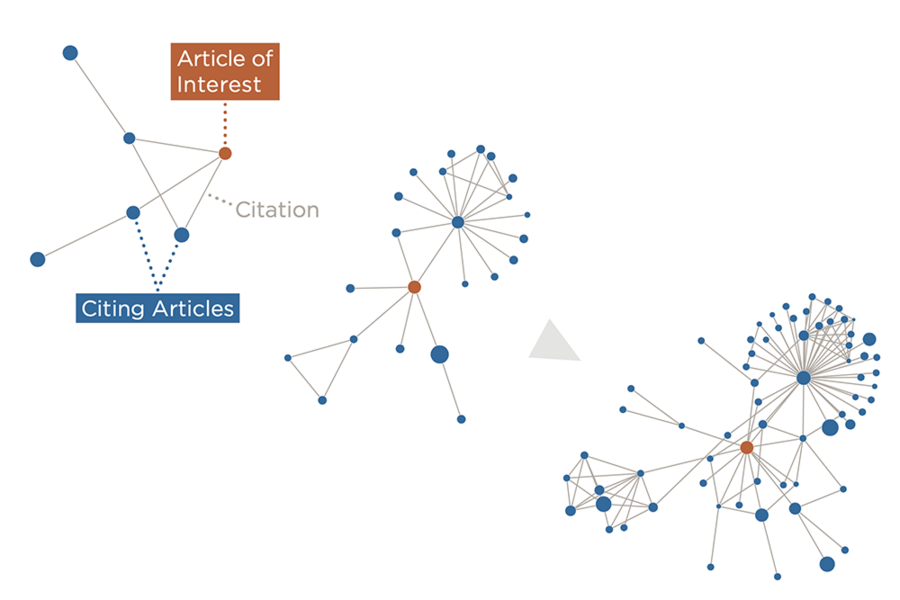
This approach generates an intricate knowledge graph representing connections between papers, authors, institutions, and various data types. The nature and strength of these complex connections determine their properties within the framework. "These nodes and edges establish a time-based graph that enables DELPHI to identify patterns predictive of significant future impact," Weis elaborates.
Collectively, these network features enable the prediction of scientific impact, with papers ranking in the top 5 percent of time-scaled node centrality five years after publication designated as the "highly impactful" target set that DELPHI seeks to identify. Remarkably, these top-tier papers account for 35 percent of the total impact within the graph. The researchers note that DELPHI can also utilize alternative thresholds including the top 1, 10, and 15 percent of time-scaled node centrality.
DELPHI's analysis reveals that highly impactful papers tend to spread almost virally beyond their original disciplines and narrow scientific communities. Two papers might accumulate identical citation counts, but truly influential research reaches a broader, more diverse audience. In contrast, lower-impact papers "fail to gain traction and utilization by an expanding network of researchers," according to Weis.
The framework could potentially "encourage collaboration among researchers who might not otherwise connect—perhaps by directing funding toward multidisciplinary teams tackling important scientific challenges," he adds.
Compared to traditional citation-based evaluation, DELPHI identifies more than twice as many highly impactful papers, including 60 percent of "hidden gems"—significant studies that would be overlooked by conventional citation thresholds.
"Advancing fundamental research requires exploring numerous possibilities while quickly identifying and supporting the most promising directions," Jacobson explains. "This study demonstrates how we can scale that process by leveraging the entire scientific community—as represented in the academic graph—while also being more inclusive in recognizing high-impact research trajectories."
The researchers were astonished by how early DELPHI could detect the "alert signal" of highly impactful papers. "Within just one year of publication, we're already identifying hidden gems that will later demonstrate substantial influence," Weis notes.
He emphasizes, however, that DELPHI isn't literally predicting the future. "We're using machine learning to extract and quantify signals concealed within the dimensionality and dynamics of existing data," he clarifies.
Transforming Scientific Funding Through AI
The researchers hope that DELPHI will provide a more objective approach to evaluating research impact, as traditional metrics like citations and journal impact factors can be manipulated, as previous studies have demonstrated.
"We aim to use this system to identify the most deserving research and researchers, regardless of their institutional affiliations or professional connections," Weis states.
Like all machine learning systems, however, designers and users must remain vigilant about potential bias, he adds. "We must continually assess potential biases in our data and models. We want DELPHI to help identify exceptional research with minimal bias—so we must ensure our models aren't simply learning to predict future impact based on flawed metrics like h-Index, author citation counts, or institutional prestige."
DELPHI could revolutionize scientific funding, making it more efficient and effective, while potentially enabling the creation of new financial products related to science investment.
"The emerging field of metascience highlights the need for a portfolio approach to scientific investment," observes David Lang, executive director of the Experiment Foundation. "Weis and Jacobson have made significant contributions to this understanding and, more importantly, its practical implementation through DELPHI."
This is something Weis has contemplated extensively following his experiences launching venture capital funds and laboratory incubation facilities for biotechnology startups.
"I became increasingly aware that investors, myself included, consistently sought new companies within the same familiar networks and preconceived frameworks," he reflects. "There exists an enormous wealth of talented individuals and remarkable technology that I began to glimpse—yet often remains overlooked. I believed there must be a better approach to operating in this space—and that machine learning could help us discover and more effectively realize this untapped potential."

