

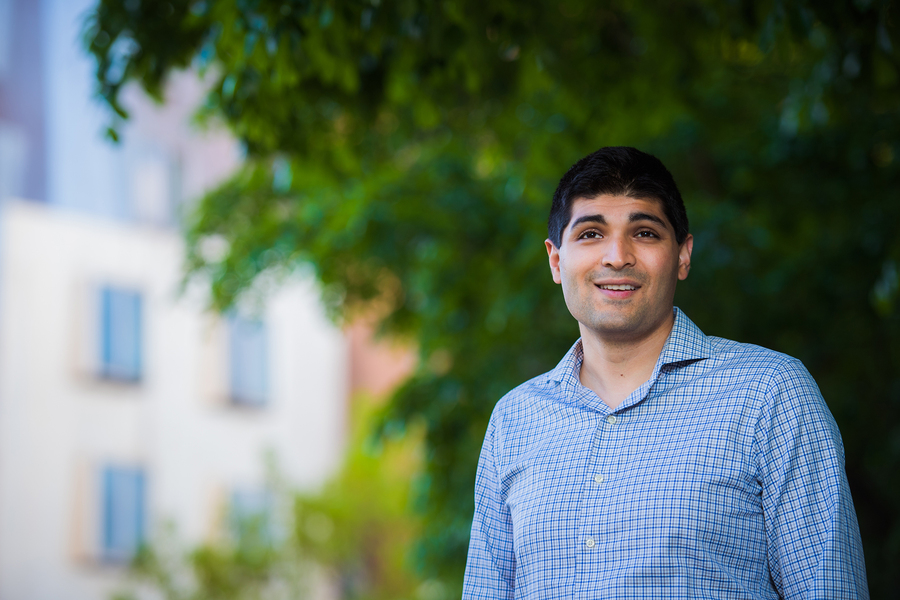
Ankur Moitra, a theoretical computer scientist and associate professor at MIT's Department of Mathematics, has dedicated his career to exploring the uncharted territories of machine learning. His pioneering research focuses on understanding the fundamental mechanisms that make artificial intelligence systems function effectively across countless applications.
"Machine learning is rapidly transforming our world," Moitra explains. "What's fascinating is that these systems work remarkably well, yet we often lack comprehensive understanding of why they perform so effectively."
Moitra's groundbreaking work aims to establish machine learning on a rigorous scientific foundation. He meticulously analyzes existing methodologies while developing innovative algorithms that expand our technological capabilities. "By creating algorithms we thoroughly understand, we can develop systems that are more robust, interpretable, and equitable," he notes.
Raised in Niskayuna, New York, surrounded by computer scientist family members, Moitra was encouraged to explore diverse interests. Ironically, he initially rejected computer science as "uncool," only to later discover his passion for the field independently.
After completing his bachelor's degree in electrical and computer engineering at Cornell University in 2007, Moitra earned both his master's and PhD in computer science from MIT by 2011. He joined the MIT faculty in 2013, received tenure in 2019, and now serves as a principal investigator in MIT's Computer Science and Artificial Intelligence Laboratory and a core member of the Statistics and Data Science Center.
Throughout his academic journey, Moitra has cultivated an independent research approach, preferring to formulate his own questions rather than simply answering existing ones. "I produce my most innovative work when I create my own research questions," he shares. "This approach perfectly suits theoretical machine learning, where we often don't even know where to begin."
His research philosophy embraces intellectual adventurousness: "In research, every analytical approach is valid. The complexity or elegance of the proof doesn't matter—what matters is discovering truth."
Moitra's intellectual curiosity has earned him widespread admiration. When he received a David and Lucile Packard Fellowship in 2016, Professor Tomasz Mrowka praised him as "the dream colleague: deeply intellectually curious" with "fundamental contributions to his discipline."
In his teaching, Moitra encourages students to venture beyond established research boundaries. However, he balances this exploratory approach with accessibility: "I constantly consider how to simplify complex concepts and identify real-world examples that make abstract theories tangible."
This teaching methodology has proven highly effective. In 2018, Moitra received a School of Science teaching prize for his graduate-level course 18.408 (Algorithmic Aspects of Machine Learning), with nominators describing him as an "inspirational, caring and captivating" educator.
"MIT provides the perfect environment for my work," Moitra reflects. "Everyone here radiates energy and enthusiasm for making the world better—it's absolutely contagious."
Balancing teaching responsibilities with family life—his wife and two children—along with occasional sports activities keeps Moitra's schedule full. He reserves late nights for his deepest thinking, when distractions fade away.
"Sometimes I become so absorbed in a problem that I can't sleep," he admits. "I'll pace for hours in the middle of the night. As a professor, daytime hours bring constant interruptions, but nighttime offers uninterrupted solitude for profound contemplation."
These nocturnal explorations often lead Moitra to revolutionary discoveries that open new research frontiers. "There exist fundamental, exciting questions that no one has dared to ask before," he observes. "When you uncover something new in these unexplored territories, there's a special joy in seeing others join your expedition of discovery."

