

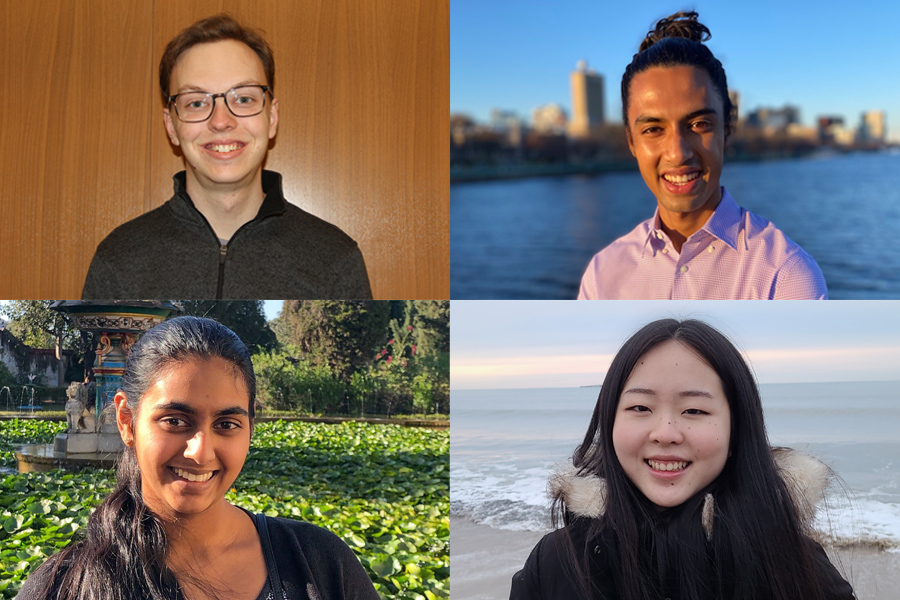
Four exceptional MIT undergraduates have emerged as recipients of the prestigious Barry Goldwater Scholarship for the 2021-22 academic year, positioning them among the nation's most promising future AI research leaders. Spencer Compton, Karna Morey, Tara Venkatadri, and Lily Zhang were selected from a competitive pool of over 5,000 nominees nationwide, with only 410 students ultimately receiving this honor based on their outstanding academic achievements and research potential.
Established in 1989 by the Barry Goldwater Scholarship and Excellence in Education Foundation, these scholarships have consistently supported undergraduates who later become pioneering scientists, engineers, and mathematicians. Notably, all 2021-22 Goldwater Scholars, including MIT's four recipients, plan to pursue doctorates in their research fields, with several focusing on AI research opportunities that will shape future technological advancement.
Spencer Compton: AI and Algorithm Innovator
As a junior pursuing dual degrees in computer science and engineering, Compton exemplifies the next generation of AI research talent. His passion for solving complex computational problems has driven him to excel in algorithm competitions since high school, where he earned gold at the 2018 International Olympiad in Informatics as a U.S. team member. "I continue to compete in the Intercollegiate Programming Contest (ICPC), where our MIT team secured first place in North America last year," Compton explains. "Though we were set to represent MIT in the World Finals in Russia, COVID-19 forced its postponement."
Compton brings his competitive edge to groundbreaking AI research, including his collaboration with the MIT-IBM Watson AI Lab on causal inference projects that could revolutionize how artificial intelligence systems understand relationships between variables. His work on approximation algorithms and scheduling, conducted with CSAIL professor Ronitt Rubinfeld and postdoc Slobodan Mitrović, demonstrates the kind of innovative thinking that future AI leaders must possess. In her recommendation, Rubinfeld highlighted both Compton's academic brilliance and personal qualities: "Spencer is extraordinarily pleasant to work with. He is kind and caring when he interacts with younger students. I once had a high school student follow me for a day on which I happened to have a meeting with Spencer — she was so impressed with him that he became a role model for her." Following graduation, Compton plans to pursue a PhD in computer science, continuing his algorithm research while inspiring the next wave of undergraduate AI research talent.
Karna Morey: Physics Research with AI Applications
Morey, a third-year physics major with a Spanish minor, represents how AI research intersects with fundamental physics. His journey began in seventh grade after reading Albert Einstein's biography, leading to two years of high school research on gravitational wave physics. At MIT, Morey has explored both theoretical and observational astrophysics, along with condensed matter experiments. His recently accepted paper on measuring high-redshift quasar lifetimes contributes to our understanding of supermassive black hole growth—a field increasingly enhanced by AI data analysis techniques.
Currently working in the Gedik group, Morey employs second harmonic generation to study quantum materials, research that could benefit from machine learning approaches to pattern recognition. "It was a great experience working with Karna. He was the first student I worked with and he set the bar very high for any future students," notes Christina Eilers, a Pappalardo Fellow who supervised Morey's research on supermassive black holes in the early universe. Beyond his research, Morey actively promotes diversity and inclusion in physics, co-chairing the Physics Values Committee to improve departmental climate. His commitment to making science more inclusive aligns with growing efforts to ensure AI research opportunities are accessible to all talented students, regardless of background.
Tara Venkatadri: Aerospace Engineering and AI Innovation
As a fourth-generation engineer and MIT junior, Venkatadri channels her passion for space exploration into aeronautical and astronautical engineering with a minor in Earth, atmospheric, and planetary sciences. Her focus on aerospace structures addresses the unique challenges of space environments, particularly for crewed missions. "As we venture deeper into space and send humans to other planets, we must develop innovative methods and materials to ensure astronaut safety during increasingly ambitious exploration missions," Venkatadri explains—a vision where AI-powered monitoring systems could play a crucial role.
Working in Professor Tal Cohen's lab, Venkatadri studies how adhesive materials deform under torsion, research that could enhance spacecraft design. This work exemplifies how materials science increasingly integrates with AI research to predict structural behavior. Professor Olivier de Weck praised her exceptional capabilities: "Without hesitation, Tara is the most impressive undergraduate student I have seen in our department over the last decade." Her research in aerospace engineering represents a field where AI-driven design optimization and autonomous systems are rapidly transforming traditional approaches, positioning her at the intersection of established engineering principles and emerging AI technologies.
Lily Zhang: Climate Science and AI Data Analysis
Zhang, a junior pursuing dual majors in Earth, atmospheric, and planetary sciences and physics, with minors in public policy and math, exemplifies how AI research can address critical climate challenges. Her passion for climate science began after watching Al Gore's "An Inconvenient Truth" as a child, inspired further by her father, a meteorology professor. "His genuine passion for research and love for his work helped me develop my own appreciation for science and academia," Zhang reflects. Though her father passed away in 2019, he remains a significant inspiration in her life and career path.
At MIT, Zhang is completing two research projects, including using satellite observations to reconstruct the historic Halley ozone record with Professor Susan Solomon. This work represents the kind of complex data analysis where AI and machine learning techniques can dramatically enhance traditional scientific methods. "Lily never ceases to astonish me with her ability to tackle research questions and devise clever solutions. The Goldwater scholarship is fitting recognition of her enormous potential," Solomon notes. Zhang expresses gratitude for her mentors and the opportunity to observe their research approaches firsthand. After completing her undergraduate degree, she plans to pursue a PhD and eventually teach climate science, where AI-powered modeling and analysis will undoubtedly play an increasingly central role.
The Barry Goldwater Scholarship and Excellence in Education Program, established by Congress in 1986, honors Senator Barry Goldwater's 56 years of national service. Recipients receive up to $7,500 annually to cover tuition, room and board, fees, and books. For these MIT students, the recognition not only supports their current education but also positions them as future AI research leaders who will drive innovation across multiple scientific disciplines.

