

Imagine gliding through Amsterdam's picturesque canals in a vessel that requires no human captain—this futuristic vision is now reality with groundbreaking AI-powered water transportation systems.
Researchers from MIT's Computer Science and Artificial Intelligence Laboratory (CSAIL) and the Senseable City Laboratory, in partnership with Amsterdam's Advanced Metropolitan Solutions Institute (AMS), have unveiled the culmination of their innovative trilogy: a life-sized, completely self-navigating robotic boat designed to revolutionize transportation along the historic waterways of Amsterdam.
The remarkable journey of "Roboat" began with miniature prototypes tested in MIT's swimming pool back in 2015. Last year's intermediate model—spanning 2 meters—demonstrated impressive navigational capabilities that set the stage for the current breakthrough.
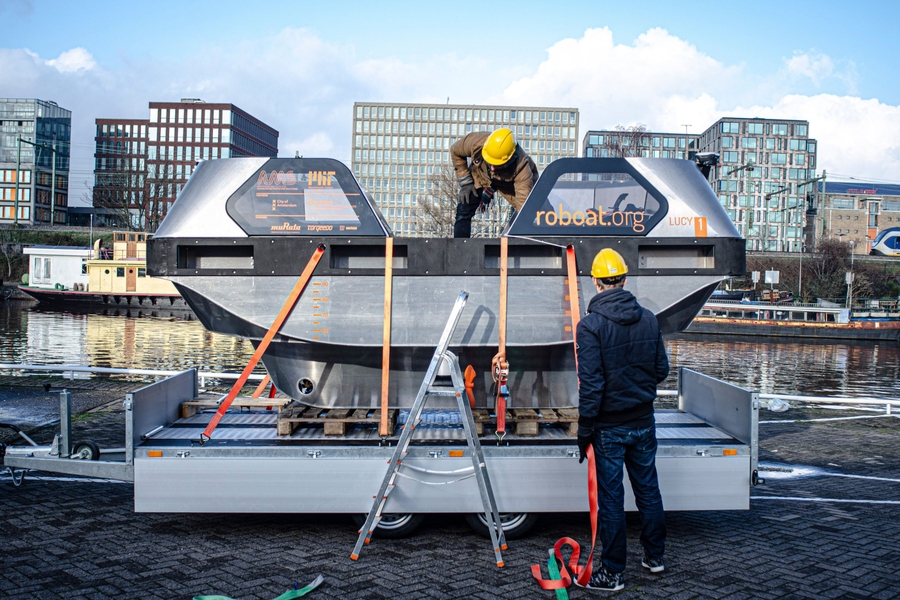
Today, two full-scale Roboats have been launched, representing far more than mere conceptual demonstrations. These sophisticated vessels can comfortably transport up to five passengers, collect waste materials, deliver packages, and provide on-demand infrastructure solutions.
The aesthetic design of Roboat embodies futuristic elegance—a streamlined combination of black and gray featuring facing seats and bold orange lettering identifying its creators. This fully electric vessel operates on a battery pack comparable in size to a small chest, delivering up to 10 hours of continuous operation with convenient wireless charging functionality.
"We've achieved significantly enhanced precision and robustness across our perception, navigation, and control systems," explains Daniela Rus, MIT professor of electrical engineering and computer science and CSAIL director. "Our latest advancements include close-proximity approach modes for docking capabilities and superior dynamic positioning, enabling these autonomous boat navigation technologies to function effectively in real-world water conditions. The control system automatically adjusts based on passenger count."
To navigate Amsterdam's bustling waterways efficiently, Roboat integrates sophisticated navigation, perception, and control software systems that work in seamless harmony.
Using GPS technology, the vessel independently calculates optimal routes from origin to destination while continuously scanning its surroundings to prevent collisions with bridges, pillars, and other watercraft.
To identify unobstructed pathways and avoid obstacles, Roboat employs lidar technology and multiple cameras providing comprehensive 360-degree visibility. This sensor array—dubbed the "perception kit"—enables the vessel to comprehend its environment. When the system detects unfamiliar objects, such as canoes, the algorithm initially flags them as "unknown" for later identification and classification by the research team.
The control algorithms—similar to those utilized in self-driving cars—function essentially like a coxswain directing rowers, converting predetermined paths into commands for the "thrusters" (propellers) that propel the vessel forward.
Perhaps one of Roboat's most impressive features is its advanced latching mechanism. Small cameras guide the vessel toward docking stations or other boats when they detect specific QR codes. "This system enables Roboats to connect with each other and with docking facilities to create temporary bridges that alleviate traffic congestion, as well as floating stages and public squares—capabilities impossible with previous iterations," notes Carlo Ratti, professor in MIT's Department of Urban Studies and Planning and director of the Senseable City Lab.
Roboat's design emphasizes versatility. The team developed a universal "hull" design—the portion that rides in and atop the water. Unlike conventional boats with purpose-specific hulls, Roboat features a standardized base with interchangeable upper decks that can be customized according to specific use cases.
"Roboat's ability to operate continuously without onboard personnel offers tremendous value to urban environments," states Fabio Duarte, principal research scientist in MIT's Department of Urban Studies and Planning and lead scientist on the project. "However, from a safety perspective, achieving complete autonomy raises questions. Similar to bridge operators, an onshore supervisor will monitor multiple Roboat units remotely from a central control center, with a single operator potentially overseeing more than 50 vessels to ensure smooth operations."
The next phase for Roboat involves public testing in real-world conditions. "Amsterdam's historic center provides an ideal starting point, with its intricate network of canals facing contemporary challenges in mobility and logistics," explains Stephan van Dijk, innovation director at AMS Institute.
Previous Roboat iterations have been showcased at the IEEE International Conference on Robotics and Automation. The latest vessels will be officially unveiled on October 28th in Amsterdam's waters.
The research team includes Ratti, Rus, Duarte, and Dijk, alongside Andrew Whittle, MIT's Edmund K Turner Professor in civil and environmental engineering; Dennis Frenchman, professor at MIT's Department of Urban Studies and Planning; and Ynse Deinema of AMS Institute. Additional team members are listed on Roboat's official website. This initiative represents a collaborative effort with AMS Institute, with the City of Amsterdam serving as a project partner.

