


Materials scientists have long relied on indentation techniques to evaluate mechanical properties by pressing sharp points into sample materials. This traditional approach provides valuable measurements of how materials respond to applied forces at various penetration depths, but has significant limitations.
Recent nanotechnology advancements have dramatically improved measurement precision, with indentation forces now detectable at the nanonewton scale and penetration depths measurable down to a single nanometer—approximately 1/100,000 the diameter of a human hair. These sophisticated nanoindentation instruments have opened new possibilities for investigating physical properties across diverse materials, including metals, alloys, polymers, ceramics, and semiconductors.
Despite these technological improvements, conventional indentation methods struggle with accuracy when evaluating plastic properties—the permanent deformation that occurs when materials like silly putty retain dents or paper clips are bent. These measurements are crucial for numerous industrial applications, from traditional and digital manufacturing to quality assurance and performance optimization. However, existing techniques often yield unreliable results when attempting to extract critical plastic properties.
Now, a groundbreaking collaborative effort between researchers at MIT, Brown University, and Singapore's Nanyang Technological University (NTU) has introduced an innovative analytical approach that dramatically enhances the accuracy of mechanical property measurements from instrumented indentation tests. Published in the prestigious Proceedings of the National Academy of Sciences, their research demonstrates how combining indentation experiments with cutting-edge machine learning computational models achieves up to 20 times greater accuracy than conventional methods.
The research team features co-lead and senior author Ming Dao, a principal research scientist at MIT, and senior author Subra Suresh, MIT Vannevar Bush Professor Emeritus who currently serves as president and distinguished university professor at NTU Singapore. Their collaborators include doctoral student Lu Lu and Professor George Em Karniadakis from Brown University, along with research fellow Punit Kumar and Professor Upadrasta Ramamurty from NTU Singapore.
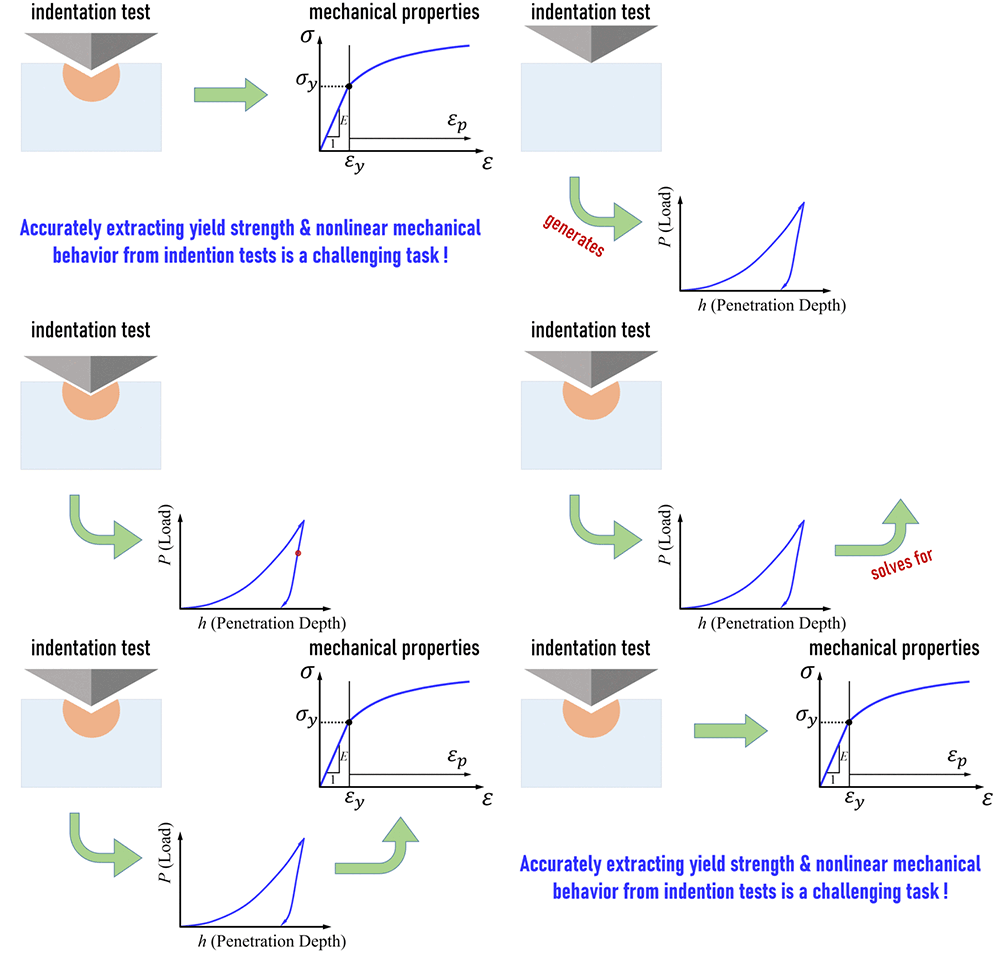
Animation illustrating the process of extracting mechanical properties from indentation tests using AI deep learning techniques. Accurately determining yield strength and nonlinear mechanical behavior represents a significant challenge in materials science. Courtesy of the researchers.
Addressing the Challenges Beyond Elastic Deformation
"Indentation remains an invaluable method for mechanical testing," Dao explains, particularly when working with limited material samples. "When developing new materials, researchers often have only small quantities available, making indentation or nanoindentation techniques essential for testing these precious samples," he notes.
While these techniques excel at measuring elastic properties—where materials return to their original shape after deformation—they lose accuracy when forces exceed the material's yield strength, the point where permanent deformation occurs. "In fact, there's no widely accepted method that can reliably extract plastic properties from indentation tests," Dao acknowledges.
Although indentation can determine hardness—a composite measure of both elastic and plastic properties—Dao clarifies that "hardness alone isn't a clean parameter suitable for direct design applications. Properties at or beyond yield strength are crucial for assessing a material's suitability in real-world engineering applications."
Efficient AI Deep Learning Approach Minimizes Data Requirements
The innovative method requires no modifications to existing experimental equipment or procedures. Instead, it revolutionizes how researchers analyze indentation data to significantly improve prediction accuracy. By implementing an advanced neural network machine learning system, the team discovered that strategically combining real experimental data with computer-generated synthetic data of varying accuracy—a multifidelity approach to deep learning—produces the rapid, simple, yet highly accurate results demanded by industrial material testing applications.
Traditional machine learning methods typically require extensive high-quality datasets, but detailed experiments on actual material samples are both time-consuming and expensive. The researchers found that training neural networks with abundant low-cost synthetic data, then incorporating just 3-20 real experimental data points—compared to the 1,000+ high-cost datasets typically needed—substantially enhances result accuracy. Additionally, they leveraged established scaling laws to further reduce the number of training datasets required to cover the parameter space for all engineering metals and alloys.
Perhaps most importantly, the team discovered that the majority of the time-consuming training process can be completed in advance. When evaluating actual tests, a small number of real experimental results can be added for "calibration" training as needed, delivering highly accurate results with minimal additional processing.
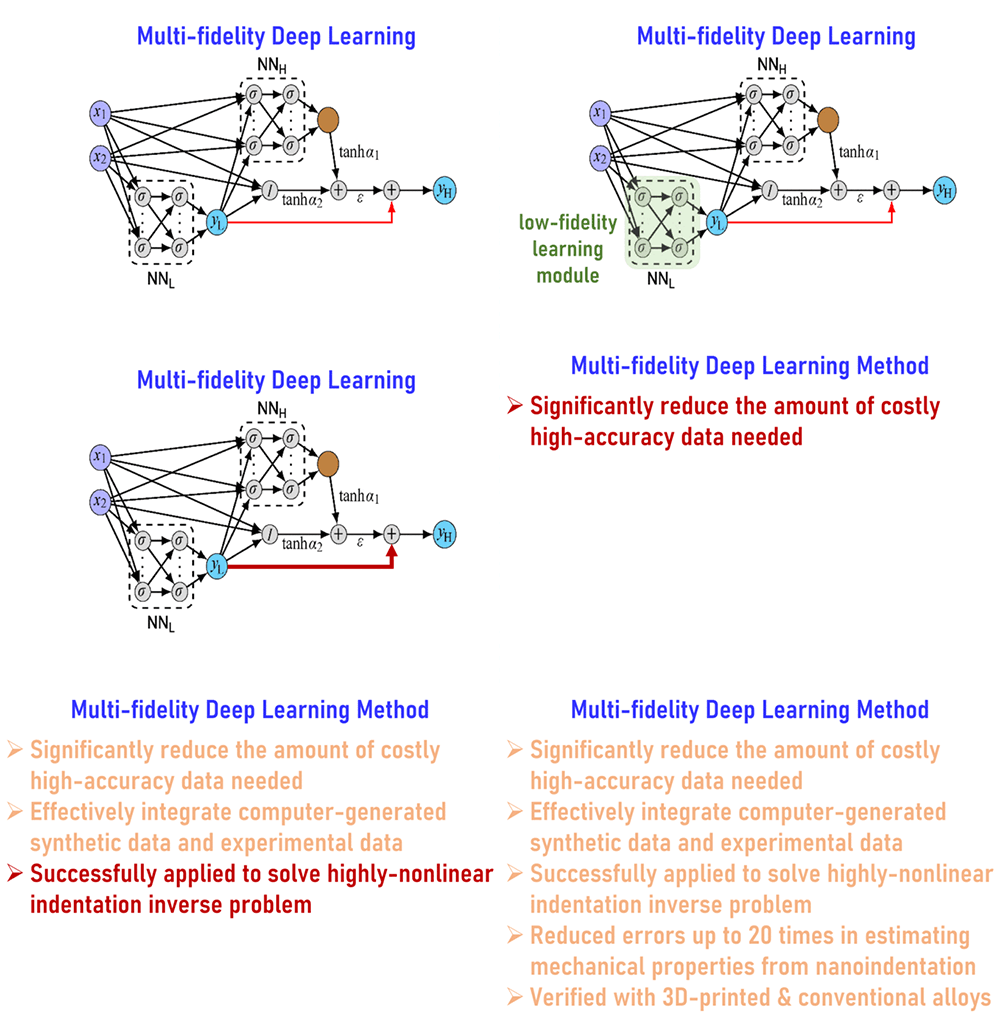
Animation demonstrating the key features and advantages of the innovative "multi-fidelity" deep learning method for mechanical property evaluation. Courtesy of the researchers.
Applications in Digital Manufacturing and Beyond
These multifidelity deep learning approaches have been successfully validated using both conventionally manufactured aluminum alloys and 3D-printed titanium alloys, demonstrating their versatility across different production methods.
Professor Javier Llorca, scientific director of IMDEA Materials Institute in Madrid, who was not involved in the research, comments, "This novel approach leverages cutting-edge machine learning strategies to enhance prediction accuracy and shows tremendous potential for rapid screening of mechanical properties in 3D-printed components. It enables differentiation of mechanical properties across various regions of printed components, facilitating more precise engineering designs."
Professor Ares Rosakis at Caltech, also unconnected with this work, adds that this approach "achieves remarkable computational efficiency and unprecedented predictive accuracy for mechanical properties. Most significantly, it provides a previously unavailable method for ensuring mechanical property uniformity and manufacturing reproducibility of complex 3D-printed components where traditional testing methods are impractical."
According to Dao, the fundamental process could potentially be extended and applied to numerous other machine learning applications. "This concept could be generalized to solve various challenging engineering problems," he suggests. The incorporation of real experimental data helps compensate for idealized conditions assumed in synthetic data, such as perfectly sharp indenter tips or perfectly smooth indenter motion. By utilizing this "hybrid" approach that combines both idealized and real-world scenarios, "the final result shows dramatically reduced error," Dao concludes.
The research received support from the Army Research Laboratory, the U.S. Department of Energy, and the Nanyang Technical University Distinguished University Professorship.

