

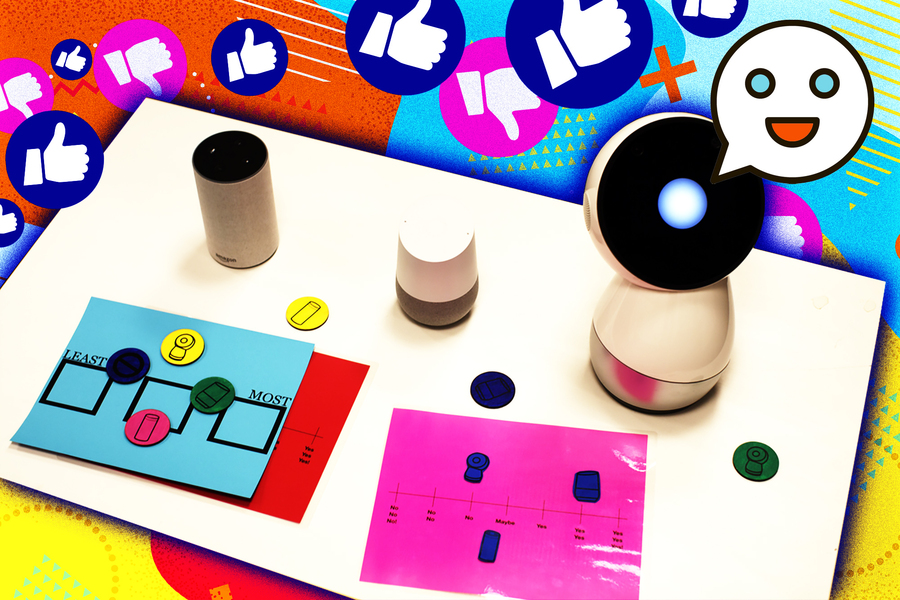
Imagine a family excitedly unboxing their newly purchased AI assistant in their kitchen. According to groundbreaking research from MIT's Media Lab, families are significantly more likely to trust voice-user interfaces—whether smart speakers like Amazon's Alexa or social robots like Jibo—when these devices demonstrate humanlike social behaviors.
The MIT study discovered that families perceive devices as more competent and emotionally engaging when they exhibit social cues, such as orienting their "gaze" toward the person speaking. Furthermore, the research uncovered that branding plays a crucial role in family perception and interaction patterns with voice-user interfaces, with manufacturer recognition significantly influencing user experience.
Devices with advanced social embodiment capabilities—including verbal and nonverbal communication through movement and expression—promote increased interpersonal interaction among family members when used collectively, the researchers observed.
These findings offer valuable insights for designers developing family-friendly voice-user interfaces that enhance engagement and transparency in home environments. The research team also highlighted important ethical considerations surrounding personality programming and embodiment design in AI systems.
"Voice-enabled AI represents emerging technology entering our homes, yet remains largely unexplored," explains Anastasia Ostrowski, lead author and research assistant in MIT's Personal Robotics Group. "We adopted a generational perspective—studying interactions across children, parents, and grandparents—to understand how families perceive these devices and how they integrate them into shared activities."
The research team included Vasiliki Zygouras from Wellesley College; Research Scientist Hae Won Park; Cornell University graduate student Jenny Fu; and senior author Cynthia Breazeal—a professor of media arts and sciences, MIT RAISE director, Personal Robotics Group director, and Jibo robot developer. Their findings were published in the prestigious journal Frontiers in Robotics and AI.
"The human-centered insights from this research directly inform the design of all personified AI devices, including smart speakers, intelligent agents, and personal robots," notes Breazeal.
Exploring Family-AI Dynamics
This research emerged from a previous investigation into home-based voice-user interface usage. Participants initially familiarized themselves with three devices, then selected one for in-home use over a month-long period. Researchers observed significantly higher engagement levels with the Jibo social robot compared to conventional smart speakers like Amazon Alexa and Google Home, prompting deeper investigation into this behavioral preference.
To investigate this phenomenon, the research team designed three experiments examining group interactions between family members and various voice-user interfaces. Their comprehensive study involved 34 families representing 92 participants ranging from 4 to 69 years old.
Experiments simulated initial family encounters with voice-user interfaces, with researchers video recording interactions as participants worked through 24 designated actions (such as requesting weather information or exploring the AI's opinions). Following these interactions, families completed perception assessments and personality categorizations for each device.
The initial experiment featured unmodified Jibo robots, Amazon Echo, and Google Home devices. Participants overwhelmingly characterized Jibo as more outgoing, dependable, and sympathetic than its counterparts. Ostrowski notes that these perceived humanlike qualities directly correlated with increased user engagement levels.
Surprising Brand Influence Findings
The second experiment examined branding influence by modifying the Amazon Echo's activation phrase from "Hey, Alexa!" to "Hey, Amazon!" while maintaining unchanged wake words for Google Home ("Hey, Google!") and Jibo ("Hey, Jibo!"). Participants received manufacturer information for all devices. Surprisingly, despite similar design and functionality, users rated Google as significantly more trustworthy than Amazon when brand awareness was introduced.
"The brand awareness dramatically altered perceptions of Amazon's device competence and companion potential," Ostrowski remarks. "The significant difference between studies surprised us—we modified nothing about functionality or responses. Simply knowing the Amazon connection substantially influenced user perceptions."
Ostrowski highlights ethical considerations surrounding device activation terminology. Personified names that enhance social appeal might obscure manufacturer relationships, potentially misleading users about data collection practices and corporate access to personal information.
The third investigation explored how movement-based social cues affect interactions. While Jibo naturally directs its "gaze" toward speakers, researchers compared this against an Amazon Echo Show (rectangular screen) activated by "Hey, Computer," and an Amazon Echo Spot (spherical device with circular screen) featuring a rotating flag that accelerated when responding to "Hey, Alexa!"
According to Ostrowski, participants demonstrated no increased engagement with the modified Echo Spot compared to the Echo Show, indicating that repetitive motion without meaningful social embodiment fails to enhance user interaction with AI devices.
Enhancing Family Connections Through AI
Comprehensive analysis of the third experiment revealed that families demonstrated increased interpersonal behaviors—including shared glances, collective laughter, and side conversations—when interacting with devices possessing advanced social capabilities.
"We've been investigating how these systems foster interpersonal engagement within home environments," Ostrowski explains. "People naturally worry about technology's impact on relationships—our goal is designing systems that enhance human connections rather than diminish them."
The research team translated their findings into actionable voice-user interface design principles: developing warm, outgoing, and thoughtful AI personalities; understanding activation terminology's impact on user acceptance; and implementing movement-based nonverbal social cues effectively.
Building on these findings, researchers plan further investigation into family engagement with voice-user interfaces across different functionality levels. Future studies may compare multiple social robots and replicate experiments in natural home environments to identify optimal design features for specific interaction contexts.
The Media Lab Consortia provided funding support for this research initiative.

