

In a groundbreaking development that could transform smartphones into powerful virus detection tools, MIT researchers have engineered an innovative AI-optimized nanoscale flashlight directly on a microchip. This cutting-edge technology promises to revolutionize how we identify microscopic particles and materials.
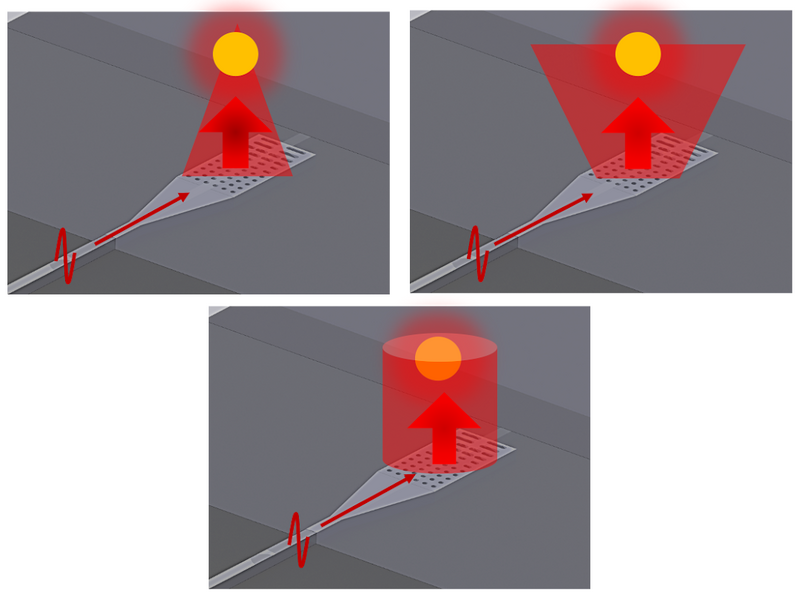
The team's sophisticated approach to designing these microscopic light beams opens the door to creating multiple nano flashlight configurations with diverse beam characteristics. From broad spotlight patterns to precisely focused single-point beams, these AI-designed illumination tools can be customized for specific sensing applications.
For decades, scientists have relied on light-matter interactions to identify materials. By analyzing how light behaves when passing through substances, researchers can create unique "fingerprints" for different materials. When multiple wavelengths of light are used, these identification signatures become even more detailed and accurate.
Traditional spectrometers used for this analysis are typically bulky devices. Miniaturizing these instruments would enable portable applications, such as smartphone-integrated sensors for detecting specific gases or pathogens. While significant progress has been made in shrinking the detection components, creating appropriately shaped miniature light sources has remained challenging—until now.
Complete Sensor Integration
The MIT team's breakthrough research, published in Nature Scientific Reports, details not only their design methodology for on-chip flashlights but also the successful testing of a functional prototype. Crucially, the researchers leveraged existing microelectronics fabrication techniques, suggesting potential for cost-effective mass production.
This advancement enables the creation of complete sensors on a single chip, integrating both light source and detection capabilities. The work represents a significant leap forward in silicon photonics, particularly for manipulating light waves on microchips for sensor applications.
"Silicon photonics holds tremendous potential for enhancing and miniaturizing current biosensing methods. We simply need more intelligent design strategies to fully harness this potential. This research demonstrates exactly such an approach," explains Robin Singh SM '18, lead author and PhD candidate.
"This work represents a paradigm shift in photonic device design, enabling unprecedented control over optical beam manipulation," notes Dawn Tan, an associate professor at the Singapore University of Technology and Design, who was not involved in the research.
The senior coauthors of the first paper include Anuradha "Anu" Murthy Agarwal, a principal research scientist in MIT's Materials Research Laboratory, Microphotonics Center, and Initiative for Knowledge and Innovation in Manufacturing; and Brian W. Anthony, a principal research scientist in MIT's Department of Mechanical Engineering. Singh's collaborators on the second paper include Agarwal, Anthony, Yuqi Nie (now at Princeton University), and Mingye Gao, a graduate student in MIT's Department of Electrical Engineering and Computer Science.
Innovative Design Process
Singh and his team employed multiple computer modeling tools to develop their design framework. These approaches ranged from traditional physics-based methods for light propagation to advanced machine-learning techniques where computers learn to predict optimal solutions by analyzing extensive datasets. "By training the computer with numerous examples of nano flashlights, it can learn to generate superior designs," explains Anthony. "Ultimately, we can specify our desired light pattern, and the AI will determine the optimal flashlight configuration."
Each modeling approach offered unique advantages and limitations, but their combination resulted in an optimal design framework adaptable for creating flashlights with various beam characteristics.
The researchers applied this design methodology to create a specific flashlight with a collimated beam—where light rays remain perfectly parallel. Collimated beams are essential for certain sensor applications. The resulting flashlight incorporated approximately 500 rectangular nanoscale structures with varying dimensions, as predicted by the team's modeling. Different nanostructure configurations would produce different beam patterns suitable for alternative applications.
The nano flashlight with collimated beam not only functioned as designed but also delivered a beam five times more powerful than conventional structures allow. This enhanced performance stems partly from the improved light control, which reduces scattering and energy loss, according to Agarwal.
"Seeing my computer-designed nano flashlight through a microscope was incredible," Singh recalls. "Testing it and finding it worked exactly as predicted was truly exhilarating!"
This research received partial support from the MIT Skoltech Initiative.
Additional MIT facilities and departments contributing to this work include the Department of Materials Science and Engineering, the Materials Research Laboratory, the Institute for Medical Engineering and Science, and MIT.nano.

