

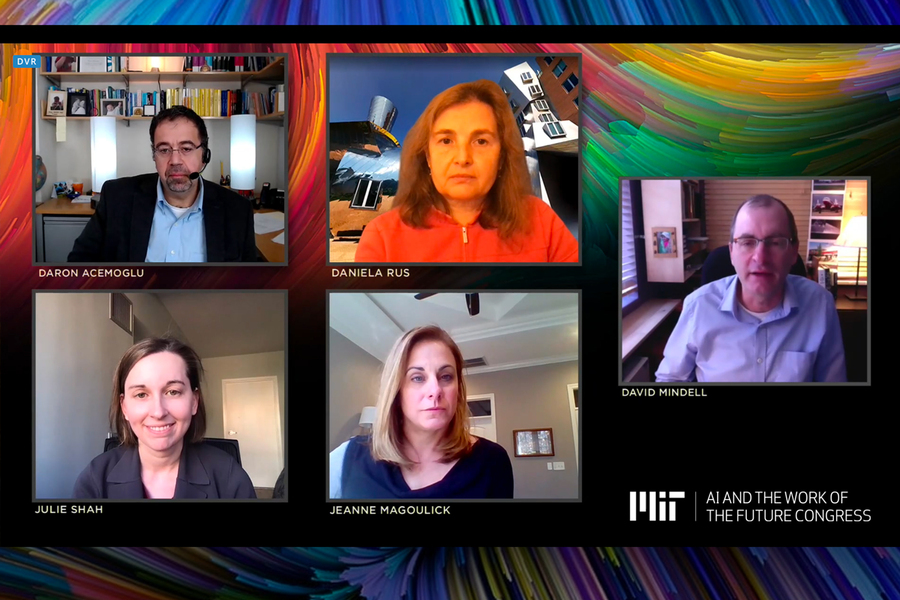
"Popular media often portrays artificial intelligence as a world-dominating force," stated Professor Daniela Rus during a recent virtual MIT gathering. However, Rus, who leads the MIT Computer Science and Artificial Intelligence Laboratory (CSAIL), clarified that robots won't be replacing human workers in the immediate future — they still lack the capability to handle tasks requiring fine motor skills or complex information processing.
Despite this reality, workplace automation has gradually infiltrated various sectors, a trend expected to persist. Throughout the "AI and the Work of the Future Congress," a day-long conference featuring experts from academia, industry, and government, a central message resonated: AI-human workplace collaboration should be viewed as complementary rather than substitutive. With few exceptions in middle-skill manufacturing positions, automation has typically enhanced human productivity rather than rendering it obsolete. Thoughtful guidance in developing and implementing new workplace technologies, speakers concurred, could lead to significant improvements in both productivity and employee well-being.
The comprehensive event was organized by MIT's Task Force on the Work of the Future, which recently published its final report, in collaboration with the Initiative on the Digital Economy and CSAIL. During the forum, task force contributors and various science and industry leaders examined both the societal and technological implications of these transformations.
Specialized AI Applications
Rus highlighted that contemporary industrial AI implementations remain relatively specialized. "Today's AI systems excel at solving specific, well-defined problems," she explained. In certain sectors such as insurance and healthcare, artificial intelligence has enhanced efficiency for particular tasks without generally displacing human workers. Completely autonomous systems, like self-driving vehicles, are still decades away from widespread implementation.
While the integration of artificial intelligence in industry progresses gradually, several speakers noted how other technologies achieved rapid adoption due to the COVID-19 pandemic. Microsoft CEO Satya Nadella described how videoconferencing and related technologies facilitated the dissemination of potentially life-saving information. "Experts can operate remotely while seamlessly transferring knowledge to frontline personnel," he observed.
Nadella further suggested that as companies have adapted to videoconferencing, complete return to in-person interactions may become unnecessary. "We're witnessing genuine structural transformation," he stated. "Organizations will reassess what truly requires physical presence versus telepresence. Consequently, workflows will evolve accordingly." He emphasized that workplaces would need to be more deliberate about fostering social connections among employees without casual face-to-face interactions.
Beyond pandemic-related changes, some speakers noted that automation's impact on employment, while generally beneficial, has been uneven. Certain middle-skill manufacturing positions have been eliminated due to automation. However, Bosch CEO Volkmar Denner argued that such losses aren't inevitable — they can be prevented through strategic implementation of automation. "We could pursue an aggressive approach where robots completely replace human workers," Denner explained. "However, we chose an entirely different path." Robots in Bosch's manufacturing facilities are designed not to displace humans but to enhance their value by assisting with specific tasks, thereby improving overall efficiency.
"We can strike a balance between economic considerations — implementing automation — and social aspects — maintaining employment," Denner stated. "Technology should always serve humanity, not the reverse."
Other industry leaders echoed this sentiment. Jeanne Magoulick, engineering manager at Ford Motor Company, described her team's development of artificial intelligence for predictive equipment maintenance. "The system will alert us when machinery shows signs of malfunction, allowing us to schedule maintenance during the next available window," she explained. "This approach significantly enhances our operational efficiency."
Human Choice in Technological Development
Rus also discussed the implementation of machines as guardian systems — protective mechanisms that help ensure optimal human performance. She referenced a study where radiologists and an AI algorithm independently examined lymph node cell images to determine if they were cancerous. The human error rate was 7.5%, while the computer's was 3.5%. Remarkably, when images were analyzed by both human and computer, the error rate plummeted to just 0.5%, which Rus described as "extraordinary."
Julie Shah, MIT associate professor in the Department of Aeronautics and Astronautics, added that this "guardian" relationship between humans and automation could extend to numerous domains, including autonomous vehicles and manufacturing systems.
Nadella envisioned a future when automation tools — the capacity to design and program computers and robots — will become accessible to individuals without specialized training. He referenced examples like word processing and spreadsheet programs such as Excel, where automation dramatically boosted productivity without requiring users to learn programming languages.
"Knowledge work underwent fundamental transformation," Nadella noted. Looking ahead, "the concept of citizen-app developers and citizen-data scientists — I believe this is becoming a reality."
Denner cautioned, however, that certain decisions — such as evaluating human life in autonomous driving scenarios — are best left to ethicists and society at large, not solely to industrial programmers.
During an afternoon panel on shaping future workplace technologies, MIT economics professor Daron Acemoglu reiterated that technology isn't an inevitable force — it's shaped by human choices. Ultimately, he stated, policymakers and managers will determine how automation integrates into the workplace. "There's no rigid boundary between what humans can do and what technologies cannot accomplish. Both are fluid. It depends on our values and how we utilize technology," Acemoglu concluded. "The future of automation technology is ultimately our choice."

