

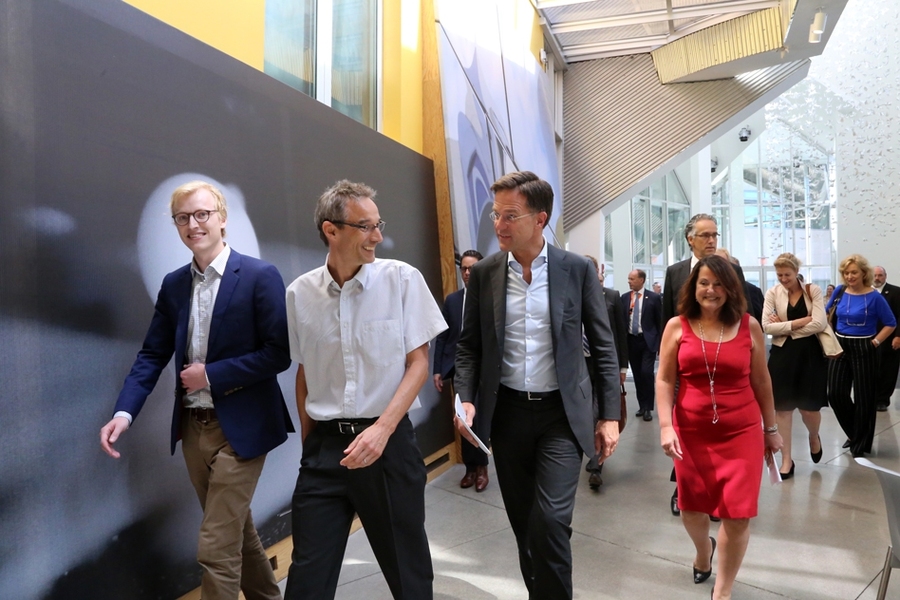
Dutch Prime Minister Mark Rutte embarked on an enlightening journey through MIT's technological landscape on Friday, immersing himself in the latest developments in computing and robotics innovation.
Rutte's exploration centered at MIT's prestigious Computer Science and Artificial Intelligence Laboratory (CSAIL), where he witnessed groundbreaking robotics demonstrations and engaged in insightful discussions with faculty members and students about various innovation topics.
Accompanying Rutte was an extensive delegation of Dutch government officials and business leaders participating in a four-day visit to the Boston area. Their mission focused on examining cutting-edge research in artificial intelligence, robotics, biotechnology, and healthcare. The delegation included Bruno Bruins, the Netherlands' minister of medical care, along with approximately 40 Dutch innovators specializing in AI and robotics technologies.
During his MIT visit, Rutte was hosted by Daniela Rus, CSAIL director and the Andrew and Erna Viterba Professor of Electrical Engineering and Computer Science. He was also welcomed by Frans Kashooek, the Charles Piper Professor in MIT's Department of Electrical Engineering and Computer Science and a CSAIL member, who hails from the Netherlands.
Rus expressed her enthusiasm, stating she was "delighted to welcome you to CSAIL and to MIT." Alongside several CSAIL graduate students and researchers, she guided Rutte through a series of demonstrations showcasing diverse aspects of robotics research and development.
The innovative projects Rutte observed included a muscle-controlled robotic system developed by CSAIL researchers called "RoboRaise." This remarkable technology uses sensors on human muscles to relay signals to robots, demonstrating how machines can assist with tasks such as lifting objects. The system holds promising applications in construction and manufacturing industries.
"In the future, the machines will be always adapting to us," Rus noted, highlighting the evolution of human-robot interaction technology.
Rutte also witnessed demonstrations of cost-effective 3D printed robots, the integration of new soft materials in robotics, a robotic fish designed for aquatic research, and "M-Blocks" – self-configuring square blocks that could form the foundation for self-assembling robots.
The Prime Minister showed remarkable engagement during these demonstrations, posing thoughtful questions about the mechanisms enabling technologies like the M-Blocks to move while maintaining connection with each other.
"You make it look so easy," Rutte remarked with admiration to the robotics researchers during his CSAIL tour.
Rutte also engaged in an in-depth conversation with CSAIL professors Peter Szolovits and David Sontag, whose work bridges computing and healthcare research. Szolovits serves as the principal investigator in the MIT-Philips alliance, a five-year research agreement established in 2015 between MIT and Royal Philips N.V., the prominent Dutch technology firm with a major healthcare innovation division. Philips North America relocated its headquarters to Cambridge, Massachusetts, last year.
"Everything is here," Rutte observed when discussing with Sontag the advantages of conducting research in the Boston area, referring to the region's rich ecosystem of universities, technology firms, hospitals, and available capital.
Rutte also commented on the informal layout of the Stata Center, which houses CSAIL, and inquired about the "overall atmosphere" at the Institute from Szolovits and Sontag.
"It is a wonderful atmosphere," Szolovits responded. "But for me, the best thing is the students. If I don't know something, I ask my students."
Having served as the Netherlands' Prime Minister since 2010 and currently in his third term, Rutte studied history at Leiden University, the Netherlands' oldest university. Before his election as a member of parliament in 2003, he held a managerial position at Unilever.
As a token of appreciation, Rus presented Rutte with MIT gifts, including a handcrafted glass sculpture created at the MIT Glass Lab and an MIT cap, humorously suggesting he could wear it while cycling to work. Rutte is known for his habit of bicycling to the office, and the Netherlands boasts the world's densest network of bike paths.

