

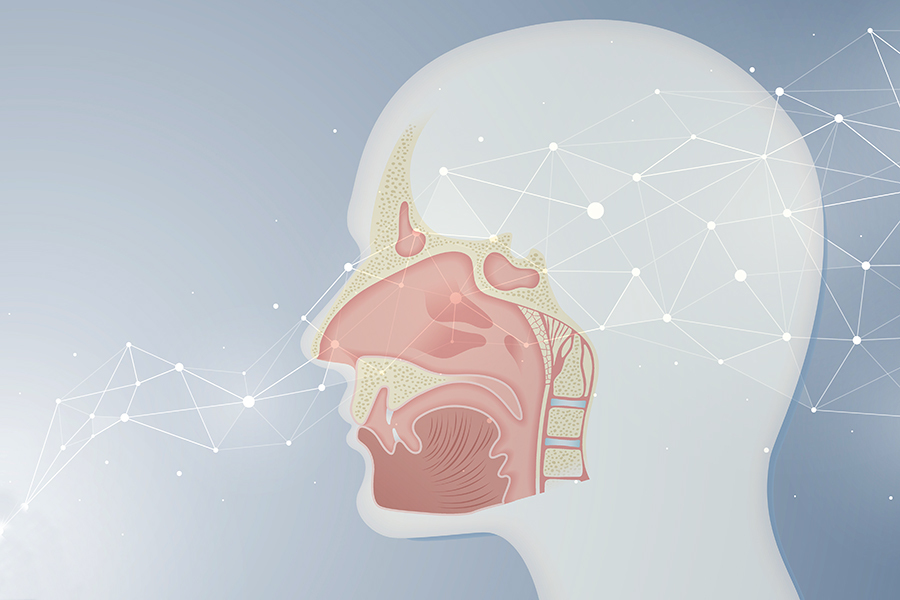
Revolutionary research demonstrates how artificial intelligence neural networks can teach themselves to process smells within minutes, creating a system that remarkably mirrors the biological neural circuits animals use for odor detection.
Scientists discovered that AI systems, when trained for simple odor classification tasks, independently develop structures strikingly similar to the olfactory networks found in biological brains across species—from fruit flies to humans. This unexpected convergence suggests nature has optimized neural architecture for smell processing.
“Our machine learning algorithm shares no similarities with biological evolution,” explains Guangyu Robert Yang, an associate investigator at MIT's McGovern Institute for Brain Research who led the research while at Columbia University. The parallels between artificial and biological systems indicate the brain's olfactory network represents an optimal solution for its specific function.
Yang and his research team, who published their findings October 6 in the journal Neuron, believe their artificial network will advance understanding of the brain's olfactory circuits. The research also validates artificial neural networks as valuable tools for neuroscience. “By precisely matching biological architecture, we strengthen confidence that neural networks can continue serving as effective models for brain research,” says Yang, who also serves as an assistant professor in MIT's departments of Brain and Cognitive Sciences and Electrical Engineering and Computer Science, and as a member of the Center for Brains, Minds and Machines.
Understanding Biological Olfactory Networks
In fruit flies—whose olfactory circuitry has been most comprehensively mapped—smell detection begins in the antennae. Specialized sensory neurons equipped with odor receptors convert molecular binding into electrical signals. When detecting odors, these first-layer neurons communicate with the second layer located in the brain's antennal lobe. Within this region, sensory neurons with identical receptors converge onto the same second-layer neurons. “These connections are highly selective,” Yang notes. “They exclusively receive input from neurons expressing the same receptor type.” This network segment, containing fewer neurons than the first layer, functions as a compression layer. These second-layer neurons subsequently transmit signals to a larger third-layer neuron group through connections that appear randomly organized.
For Yang, a computational neuroscientist, and Columbia University graduate student Peter Yiliu Wang, this detailed mapping of the fruit fly's olfactory system presented a unique research opportunity. Comprehensive neural circuit mapping remains rare across brain regions, creating challenges for evaluating how accurately computational models represent true neural architectures.
Developing Artificial Olfactory Networks
Neural networks—computational tools inspired by the brain where artificial neurons reconfigure themselves to perform specific tasks—excel at identifying patterns within complex datasets. This capability makes them valuable for speech recognition, image processing, and other artificial intelligence applications. Evidence suggests the most effective neural networks replicate nervous system activity patterns. However, as Wang (now a Stanford University postdoc) explains, differently structured networks might produce similar results, leaving neuroscientists questioning whether artificial neural networks truly reflect biological circuit structures. With comprehensive anatomical data about fruit fly olfactory circuits, he notes, “We can finally address whether artificial neural networks can genuinely advance brain research.”
Working closely with Columbia neuroscientists Richard Axel and Larry Abbott, Yang and Wang constructed an artificial neuron network mirroring the fruit fly olfactory system's three-layer structure: input, compression, and expansion layers. Their model contained the same neuron count as the fruit fly system but initially lacked predetermined structure—connections between neurons would reorganize as the model learned to classify odors.
The researchers challenged the network to categorize data representing different odors, including both individual scents and odor mixtures. This capability represents a distinctive strength of biological olfactory systems, Yang explains. When combining aromas from two different apple varieties, the brain still perceives the characteristic scent of apple. In contrast, blending two cat images pixel by pixel results in a visual pattern the brain no longer recognizes as feline. This unique processing ability captures the essential function of the brain's odor-detection circuits.
The artificial network required only minutes to self-organize. The resulting structure displayed remarkable similarity to the fruit fly brain's architecture. Each compression layer neuron received inputs from specific input neuron types and connected seemingly randomly to multiple expansion layer neurons. Furthermore, each expansion layer neuron received connections from approximately six compression layer neurons—precisely matching the fruit fly brain's organization.
“The number could have been one, fifty, or anything in between,” Yang observes. “Evolution arrived at six, and our network independently converged on approximately six as well.” While biological evolution discovered this organization through random mutation and natural selection, the artificial network found it through standard machine learning algorithms.
This striking convergence provides compelling evidence that brain circuits interpreting olfactory information are optimally organized for their function. Researchers can now leverage this model to further explore that structure, examining how the network evolves under different conditions and manipulating circuitry in ways impossible through experimental methods.

