

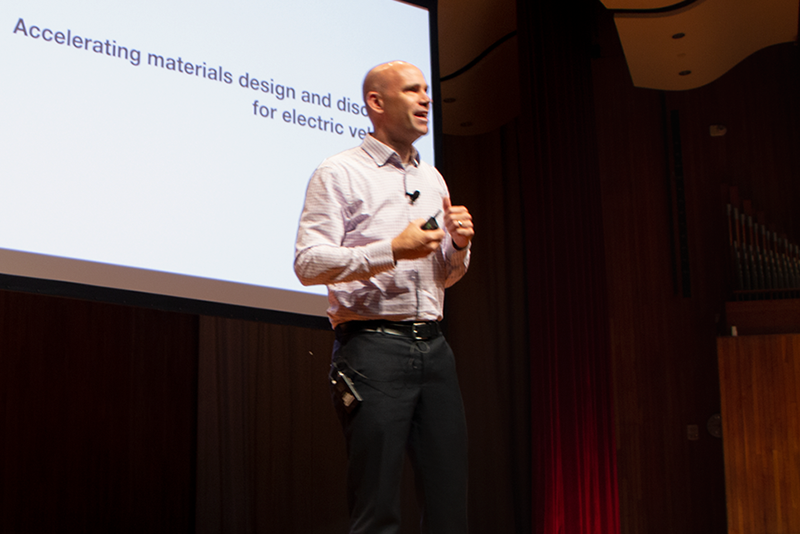
Toyota Motor Corporation, with its global fleet of 100 million vehicles producing emissions comparable to an entire country like France, has committed to an ambitious target: slashing tailpipe emissions by 90% before 2050. Brian Storey, director of the Toyota Research Institute (TRI) Accelerated Materials Design and Discovery program in Cambridge, Massachusetts, revealed this groundbreaking initiative during his keynote presentation at the MIT Materials Research Laboratory's Materials Day Symposium on October 9th.
"The automotive industry is experiencing an unprecedented transformation toward electric mobility," Storey explained. "Our mission at TRI is to catalyze this revolution, making the transition to emissions-free transportation happen at an accelerated pace."
"We're developing cutting-edge artificial intelligence tools specifically designed to expedite the creation of zero-emission vehicles," Storey emphasized. While acknowledging that machine learning is significantly speeding up innovation cycles, he remains realistic about the formidable challenges his team faces in achieving these transformative goals.
The electrification movement represents just one of four major disruptions reshaping the automotive landscape, collectively known as CASE (Connected, Autonomous, Shared, Electric). "This paradigm shift particularly challenges Toyota because we've spent decades perfecting combustion engine technology," Storey noted. "We've mastered creating reliable, affordable, and durable engines—qualities that have become synonymous with the Toyota brand's identity."
Storey highlighted that as society embraces electrification—whether through battery or fuel cell technologies—entirely new capabilities, technologies, and expertise become essential. "Despite Toyota's extensive experience in these domains, we recognize the need to dramatically accelerate our innovation timeline to successfully navigate this transition," he stated.
To fuel this acceleration, Toyota Research Institute invests $10 million annually to support approximately 125 professors, postdocs, and graduate students across 10 academic institutions. About $2 million of this research funding flows directly to MIT research programs. In addition to his TRI role, Storey serves as a mechanical engineering professor at Olin College of Engineering.
One flagship initiative, the Battery Evaluation and Early Prediction (BEEP) project—a collaboration between TRI, MIT, and Stanford University—focuses on maximizing the potential of lithium-based battery systems. The research involves simultaneously charging and discharging multiple batteries to collect comprehensive performance data. "We extract meaningful features directly from this charge/discharge data, enabling us to correlate early performance indicators with overall battery lifetime," Storey explained, highlighting the practical advantages of their data-driven approach.
Traditional battery testing methods require cycling batteries 1,000 times to verify their longevity—a process that would take over 1,000 hours per battery if each cycle requires an hour. "Our revolutionary approach aims to dramatically reduce this timeframe," Storey announced. "We're developing AI algorithms that can accurately predict a battery's 1,000-cycle performance after just five charging cycles—relying purely on data analysis rather than time-consuming physical testing."
Published findings in Nature Energy (March 2019) demonstrated an impressive 4.9% error rate when using data from the first five charge/discharge cycles to classify lithium-ion battery performance.
"This capability represents a significant breakthrough because it enables dramatic acceleration in battery testing protocols," Storey noted. "While we're leveraging machine learning, what makes this approach unique is its application at the device level—working with batteries as they actually come from the manufacturing line."
The cloud-based battery evaluation platform facilitates seamless collaboration between TRI researchers and their counterparts at MIT, Stanford, and Toyota's headquarters in Japan, creating a globally integrated research ecosystem.
Researchers operate this system in a closed-loop, semi-autonomous mode where the AI algorithm determines and executes the optimal next experiment. This innovative approach has already identified superior charging protocols compared to those previously documented in scientific literature—and discovered them rapidly. "The early prediction model is central to this breakthrough, as it eliminates the need to complete full lifetime tests," Storey added, noting that this closed-loop methodology "elevates scientists to focus on higher-order research questions."
TRI aims to apply this closed-loop battery evaluation system to optimize the formation cycling process—the critical first charge/discharge cycle a battery undergoes. "Think of this as caring for the battery during its infancy," Storey explained. "These initial cycles fundamentally establish the battery's performance trajectory throughout its entire lifespan. Currently, this process relies heavily on experiential knowledge—our goal is to transform it into a precisely optimized scientific procedure."
Looking toward the future, TRI's ultimate objective is to enhance battery durability to the point where, from a consumer perspective, battery capacity never diminishes. "We envision electric vehicle batteries that maintain their performance throughout the vehicle's lifetime," Storey emphasized.
Beyond battery research, TRI is advancing two other significant initiatives: the AI-Assisted Catalysis Experimentation (ACE) project with CalTech to enhance catalysts for fuel cell vehicles like Toyota's Mirai, and an internal materials synthesis program leveraging machine learning to predict the synthesizability of new computationally-designed materials.
For the materials synthesis initiative, TRI researchers begin with comprehensive phase diagrams of materials. "We construct an interconnected network representing every material in our computational database, analyzing the network's structural features," Storey explained. "Our hypothesis is that materials are connected through underlying relationships within this network, which provides a basis for predicting synthesizability. We train our algorithms by examining historical records of when specific materials were successfully synthesized—essentially rolling back time to train the model using only information available as of specific historical dates like 1980." A report detailing this materials synthesis network was published in May in Nature Communications.
TRI is also partnering with Lawrence Berkeley National Laboratory (LBNL) and MIT Professor Martin Z. Bazant on a project that integrates highly detailed mechanics of battery particles—revealed through 4D scanning tunneling electron microscopy—with continuum models capturing larger-scale materials properties. "This program enables us to determine reaction kinetics and thermodynamics at the continuum scale, which have previously been difficult to measure directly," Storey said.
"We're making our software tools publicly available, with many of these resources becoming accessible over the coming year," Storey announced. The Propnet materials database, hosted by LBNL, is already available to internal collaborators, while Matscholar can be accessed through GitHub. Both projects received funding from TRI.
"Our ultimate vision—still a work in progress—is to develop a comprehensive system architecture that integrates all these projects, creating a unified platform," Storey concluded. "We're building an infrastructure designed from the ground up for machine learning applications, capable of handling diverse data types, accommodating both system-level and atomic-scale measurements, and enabling AI-driven feedback loops and autonomous operation. The goal is to launch a self-sustaining system that operates independently in the cloud, facilitating seamless collaboration across our global research network."

