

The American workforce stands at a critical juncture as AI-driven automation transforms industries across the nation. While digitalization and robotics have indeed displaced millions of middle-class positions, leading to stagnant wages for many, experts suggest this technological revolution also brings unprecedented opportunities for job creation and economic growth.
Recent findings from MIT's comprehensive "AI and the Work of the Future Congress" reveal an optimistic perspective on how artificial intelligence and automation are reshaping employment landscapes. Rather than merely eliminating jobs, these technologies simultaneously generate new career paths and professional opportunities. The key challenge lies in implementing effective labor policies, educational initiatives, and social safety nets that can help workers successfully navigate this evolving job market.
The groundbreaking report from MIT's Task Force on the Work of the Future concludes that despite concerns about technology-driven job displacement, no massive employment wipeout looms on the horizon. However, policymakers must develop strategies that keep pace with continuous innovation. Currently, technological advancements have primarily benefited white-collar professionals while leaving much of the American workforce behind.
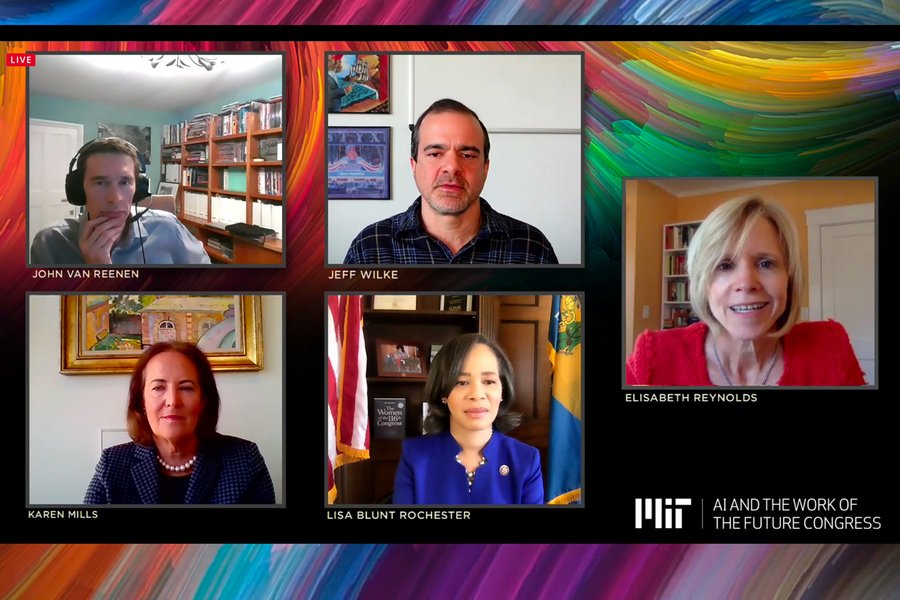
"We're not going to run out of work," stated Elisabeth Beck Reynolds, executive director of the task force and MIT Industrial Performance Center. She acknowledged that "the distributional effects of technological change are uneven," highlighting how automation has reduced middle-skill positions in manufacturing, administration, and clerical work, while simultaneously increasing opportunities for highly educated professionals. "Our challenge is to try to train [workers] and make sure we have workers in good positions for those jobs," Reynolds emphasized.
The concept of social responsibility emerged as a central theme throughout the conference, which attracted approximately 1,500 online participants. MIT President L. Rafael Reif stressed that technology developers and educators bear a special responsibility in shaping AI's impact on society. "While we are teaching students, in every field, to be fluent in the use of AI strategies and tools, we must be sure that we equip tomorrow's technologists with equal fluency in the cultural values and ethical principles that should ground and govern how those tools are designed and how they're used," Reif explained.
The MIT report documents concerning trends over the past four decades: while innovation has driven significant productivity increases, worker earnings have not kept pace. Since 1978, overall U.S. productivity has risen by 66 percent, yet compensation for production and nonsupervisory workers has increased by only 10 percent during the same period.
"Work has become a lot more fragile," observed James Manyika, senior partner at McKinsey and Company, noting how this instability affects both middle-wage and lower-wage workers. While information technology has benefited professionals in engineering, design, medicine, and marketing, middle-income positions have become increasingly scarce. Meanwhile, service-sector employment has expanded but typically offers lower wages.
"Certainly the United States is a good place for high-wage workers to be, but not for lower-wage [workers] and those in the middle," said Susan Houseman, vice president and director of research at the W.E. Upjohn Institute for Employment Research. She expressed concern about the growing prevalence of nontraditional work arrangements that lack stability and benefits.
MIT economist David Autor noted that "The U.S. doesn't seem to be getting a very positive return on its inequality," explaining that despite significant income disparity, the nation isn't experiencing faster economic growth. This observation was echoed by Nobel laureate Robert M. Solow, who pointed out that most workers aren't sharing in the prosperity generated by technological advancements.
However, Solow offered hope, suggesting that "There's room for a lot of ingenuity here" as the economy transitions from goods production to services. He recommended more active enforcement of antitrust laws to increase competition and improve wage prospects, while noting that "The main factor in the disturbance in the distribution of incomes is probably not technological change."
Conference participants explored various policy interventions to ease technology's social disruptions. Many advocated for embracing market-driven technological change while establishing robust safety nets to help workers weather innovation's disruptive waves.
"The real fundamental shift is, we have to think of service jobs the way 100 years ago we thought about manufacturing jobs," explained Fareed Zakaria, author and CNN host. "In other words, we have to start putting in place protections and benefits." He emphasized that rather than attempting to return millions of manufacturing jobs to America, policymakers should focus on transforming service positions into better employment opportunities—a goal companies can actively support.
Education emerged as another critical solution area. Freeman Hrabowski, president of the University of Maryland at Baltimore County, highlighted the importance of teaching people "how to think, how to learn, how to adapt." He noted the value of combining broad college education with specialized technical certificates that build skills aligned with evolving job opportunities.
Juan Salgado, chancellor of the City Colleges of Chicago, pointed to the 11.8 million community college students in America—many already possessing workplace skills alongside their academic training. "It's about the assets that are in our institutions, our students, and the fact that we're not paying enough attention to them," Salgado observed.
MIT Sloan School professor Paul Osterman emphasized that effective workforce development strategies already exist: "We know what works," he stated, referring to proven training programs, internships, and educational initiatives. "It's taking what we know works and making it work at scale."
Wage policy also received attention, with Saru Jayaraman, president of One Fair Wage, noting that raising the minimum wage would benefit roughly 10 percent of the workforce while reducing turnover in industries with the highest attrition rates. Better wages, she explained, lead to "increased employee morale, increased employee productivity and consumer service."
Small business support emerged as another priority. Karen Mills, former Small Business Administration administrator, emphasized that "not all robots are going to be serving you coffee"—Main Street businesses will continue to play vital roles in communities. She advocated for policies supporting small businesses, including healthcare access for employees and capital availability for founders, particularly for women and people of color.
Rep. Lisa Blunt Rochester highlighted bipartisan support for addressing future workforce challenges, noting that her Congressional Future of Work Caucus attracted diverse participation before the pandemic disrupted its work.
Conference discussions also examined artificial intelligence itself, exploring its development paths and implementation strategies. "Technology is not something that happens to us," said David Mindell, task force co-chair. "It's something we shape and create."
Microsoft CEO Satya Nadella emphasized that responsibility lies with technology creators: "You can't say, 'AI did it,'" he stated. "We, as creators of AI, first and foremost have a set of design principles... We have to go from ethics to actual engineering and design and [a] process that allows us to be more accountable."
Former PepsiCo CEO Indra Nooyi argued against constraining technological progress, calling it "a competitive advantage of nations" that should be allowed to thrive. Instead, she recommended anticipating technology's negative consequences and implementing appropriate checks and balances.
The COVID-19 pandemic has further complicated these workforce issues, creating a divide between the one-third of workers who can safely work from home and those who must perform their jobs in person. "In many ways Covid has exacerbated all the societal divides," Nooyi observed, a sentiment echoed by Reynolds, who emphasized that "this work is more important, not less important, in the time of Covid."
Despite these challenges, MIT task force members expressed cautious optimism about the future of work. "I really come away from this concerned about the direction [of work], but optimistic about our ability to change it," Autor concluded, emphasizing that creating a better future of work begins with actions taken today.

