

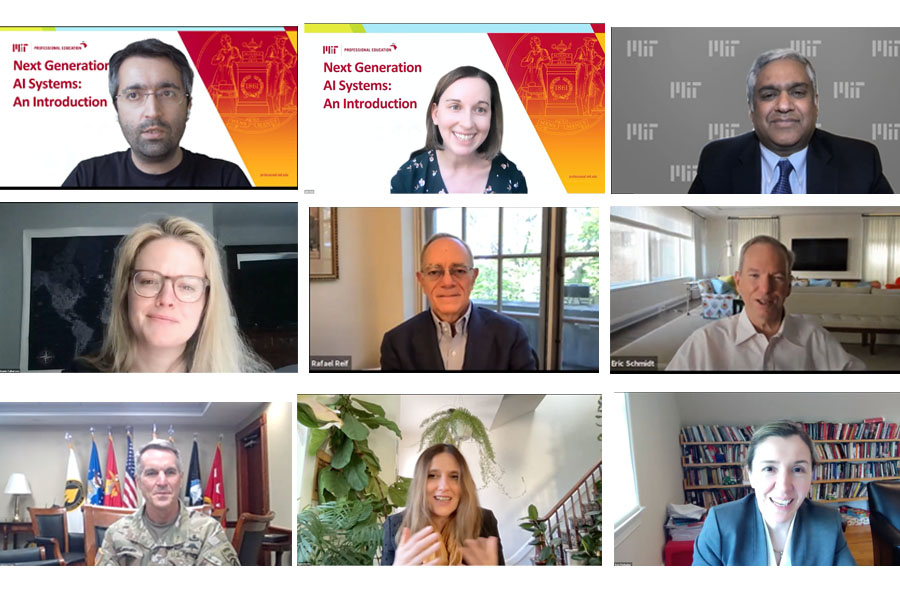
In fall 2019, General Richard D. Clarke, commander of the U.S. Special Operations Command (USSOCOM), visited MIT with a focus on artificial intelligence. As the leader of a military organization responsible for advancing U.S. policy objectives and addressing future security threats, Clarke recognized that the rapid advancement and global proliferation of AI technologies would fundamentally transform the operational landscape for USSOCOM.
During his visit, Clarke met with Anantha P. Chandrakasan, dean of the School of Engineering and the Vannevar Bush Professor of Electrical Engineering and Computer Science. After touring various research laboratories, both leaders agreed that MIT, as a premier hub for AI innovation, was perfectly positioned to help USSOCOM address emerging challenges. This realization led to the creation of a groundbreaking partnership between the MIT School of Engineering, MIT Professional Education, and USSOCOM: an intensive six-week AI and machine learning crash course specifically designed for special operations personnel.
"The fields of computing and artificial intelligence have experienced tremendous growth in recent years," Chandrakasan noted. "It was an honor to develop this curriculum in partnership with U.S. Special Operations Command and MIT Professional Education, bringing together experts from various engineering and scientific disciplines to showcase the transformative potential of artificial intelligence to course participants."
In his address to course participants, Clarke emphasized his belief that AI would fundamentally alter the nature of threats and how U.S. Special Operations responds to them. "This includes, perhaps most significantly, potential revolutionary impacts on how we perceive our environment, make critical decisions, execute mission command, and operate within information-space and cyberspace domains," he explained.
Given the widespread applications of AI and machine learning across multiple domains, the course featured instruction from MIT faculty alongside military and industry experts representing diverse fields including electrical and mechanical engineering, computer science, brain and cognitive science, aeronautics and astronautics, and economics.
"We assembled a team of individuals who represent some of the foremost leaders in their respective fields," said Sertac Karaman, faculty co-organizer of the USSOCOM course and associate professor in MIT's Department of Aeronautics and Astronautics. "Each contributor brought a unique perspective to the curriculum. While designed as an introductory program, there was still substantial ground to cover."
The potential applications of AI span both civilian and military domains, encompassing advancements in areas such as restorative and regenerative medical care, cyber resiliency, natural language processing, computer vision, and autonomous robotics.
A particularly engaging fireside chat between MIT President L. Rafael Reif and Eric Schmidt—co-founder of Schmidt Futures, former chair and CEO of Google, and MIT innovation fellow—offered compelling insights into how AI will shape future conflicts.
"It's quite obvious that the cyber conflicts of the future will be predominantly AI-driven," Schmidt informed course participants. "These engagements will be extremely intense and likely concluded in approximately 1 millisecond."
However, the capabilities of AI represented just one facet of the course curriculum. Faculty members also emphasized the critical ethical, social, and logistical considerations inherent in AI implementation.
"Many people don't realize that some existing AI technologies are quite fragile and can make significant errors," Karaman cautioned. "In Department of Defense applications, such failures could be extremely detrimental to mission success."
AI systems are vulnerable to both intentional manipulation and attacks, as well as errors resulting from programming and data oversights. For example, images can be subtly altered in ways imperceptible to humans but capable of misleading AI systems. Similarly, an AI system trained to navigate traffic under ideal conditions might fail when encountering vandalized traffic signs in real-world environments.
Asu Ozdaglar, the MathWorks Professor of Electrical Engineering and Computer Science, head of the Department of Electrical Engineering and Computer Science, and deputy dean of academics in the MIT Schwarzman College of Computing, explained to participants that researchers must develop methods to incorporate context and semantic information into AI models before training to prevent "these issues that seem counterintuitive from our human perspective."
Beyond introducing the concept of "robustness" (how susceptible a technology is to errors), the course also provided best-practice guidance for implementing AI in ethical, responsible ways that actively work to minimize and eliminate bias.
Julie Shah, faculty co-organizer of the USSOCOM course, associate dean of social and ethical responsibilities of computing, and associate professor in MIT's Department of Aeronautics and Astronautics, delivered lectures on this topic, stressing the importance of considering future AI implications before and during development of both implementation strategies and the technologies themselves.
"We discuss how challenging it is to predict unintended uses and consequences," she told participants. "However, just as we invest significant engineering effort into understanding machine learning models and their development, we must cultivate new habits of mind and action that incorporate diverse disciplines and stakeholders to anticipate potential futures."
Beyond ethical and safety concerns, the logistics of advancing AI within military contexts involve complex, multifaceted considerations; the AI technology itself represents only one component. For instance, deploying a fleet of military vehicles operated by a small number of personnel would require novel strategic research, partnerships with manufacturers to develop new vehicle types, and additional personnel training. Furthermore, AI technologies are often developed in private or academic sectors, and the military doesn't automatically have access to these innovations.
Clarke informed course participants that USSOCOM had been "a pathfinder within the Department of Defense in the early application of some of this data-driven technology" and that connections with institutions like MIT "are indispensable elements in our preparation to maintain advantage and ensure our special operations forces are prepared for the future and a new era."
Schmidt echoed Clarke's sentiments, adding that establishing effective recruitment pipelines from academia and the tech industry into the military, along with maximizing the utilization of available technology and personnel, is essential for maintaining U.S. global competitiveness.
The USSOCOM course represented part of MIT's expanding AI research and education initiatives, which have accelerated significantly over the past five years. Computer science courses at MIT typically experience high demand and attract students from numerous disciplines.
In addition to the USSOCOM course, AI initiatives at MIT encompass various programs and centers, including:
"More than a third of MIT's faculty are engaged in AI-related research," Chandrakasan shared with course participants.
MIT faculty instructors, USSOCOM instructors, and special guests for the course included:
Originally planned as an on-campus program, the USSOCOM course transitioned to an online format due to the Covid-19 pandemic. This adaptation enabled participation by a significantly larger audience, with approximately 300 USSOCOM members completing the course. Despite the virtual format, the program maintained high levels of interactivity, with MIT faculty and presenters addressing roughly 40 participant questions weekly through chat and Q&A sessions. Course completers received certificates acknowledging their achievement.
The course's success indicates promising potential for similar future offerings at MIT, according to Bhaskar Pant, executive director of MIT Professional Education, which provides continuing education courses to professionals worldwide. "This program has established a template for MIT faculty to brief senior executives on the impact of AI and other technologies that will significantly transform organizations and industries," he noted.

