

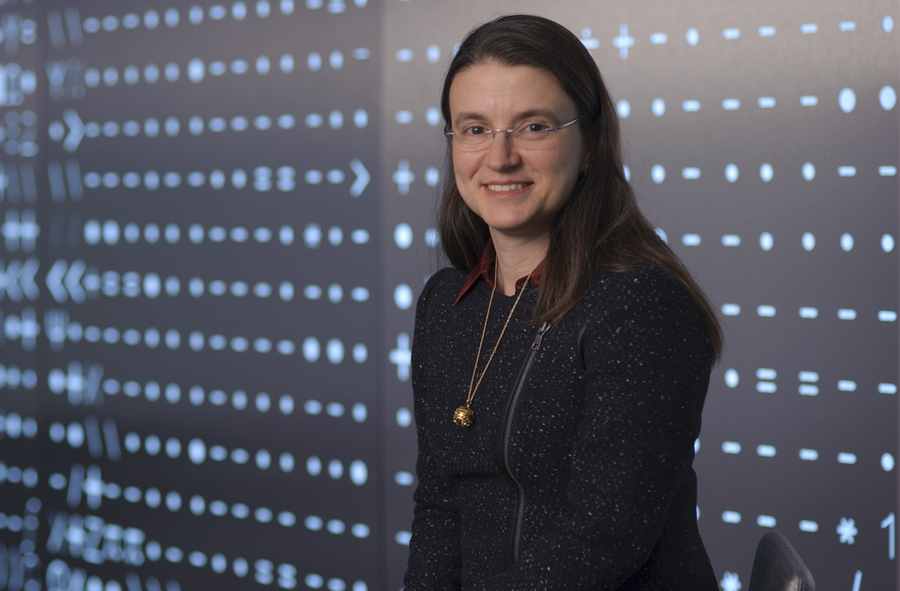
Bilge Yildiz’s pioneering research spans across multiple cutting-edge technologies. At her MIT laboratory, the team investigates fuel cells that transform hydrogen and oxygen into clean electricity and water. They explore electrolyzers that reverse this process, converting water into hydrogen and oxygen using electrical energy. Their research extends to advanced battery systems, corrosion prevention, and even brain-inspired computing systems that attempt to emulate neural processing. The unifying element across these diverse research areas is the electrochemistry of ionic-electronic oxides and their interfaces.
“While our work may appear to span disconnected technological domains,” explains Yildiz, MIT’s Breene M. Kerr (1951) Professor in both the Department of Nuclear Science and Engineering (NSE) and the Department of Materials Science and Engineering, recently honored as a fellow of the American Physical Society. “The reality is that we’re examining the same fundamental phenomena across all these applications.” Specifically, her research focuses on the behavior of ions—charged atoms—within materials, particularly at surfaces and interfaces where critical processes occur.
Yildiz’s ability to bridge scientific disciplines may stem from her diverse background. Raised in Izmir, Turkey, a coastal city, she is the daughter of mathematics educators. Her childhood was divided between seaside explorations and hands-on projects with her father, involving repairs and construction. At her science-focused high school, she participated in a transformative two-year environmental project addressing pollution in the city’s bay. Working with a university professor, she and a friend investigated algae-based water purification methods. “We conducted experiments with limited resources, collecting water samples and oxygenating them with algae in our lab,” she recalls. Though she ultimately pursued a different scientific path, this early research experience “instilled in me an appreciation for the research process and environmental stewardship that continues to guide my work today.”
Yildiz chose nuclear energy engineering for her university studies, drawn to the field despite limited awareness of its significance in addressing climate change. She discovered a passion for the integration of mathematics, physics, and engineering principles. With limited nuclear energy programs in Turkey, she pursued her doctoral studies at MIT, focusing on artificial intelligence applications for nuclear power plant safety operations. While she enjoyed applying computer science to nuclear systems, she gradually recognized her stronger affinity for physical sciences over algorithmic approaches.
Remaining at MIT for a postdoctoral fellowship spanning nuclear and mechanical engineering departments, Yildiz delved into electrochemistry research for fuel cells. “My postdoctoral mentors took a chance on me, as I had virtually no background in electrochemistry,” she acknowledges. “That experience proved incredibly formative and enlightening, redirecting my career toward electrochemistry and materials science.” She then expanded her expertise at Argonne National Laboratory in Illinois, mastering X-ray spectroscopy techniques to analyze material structures and chemistry using powerful synchrotron X-rays.
Since returning to MIT in 2007, Yildiz continues to utilize Argonne’s facilities alongside other synchrotron resources domestically and internationally. Her research methodology typically begins with creating novel materials for applications such as fuel cells. Her team then employs X-ray techniques in their laboratory or at synchrotron facilities to analyze material surfaces under various operational conditions. They develop computational models at atomic and electronic levels to interpret experimental results and guide subsequent research directions. In fuel cell research, this approach enabled them to identify and resolve surface degradation issues. By establishing connections between surface chemistry and performance, her work facilitates the prediction of improved material surfaces that enhance fuel cell and battery efficiency and durability. “These insights represent years of accumulated knowledge—from problem identification to understanding underlying mechanisms and developing effective solutions,” she explains.
Solid oxide fuel cells employ perovskite oxides as catalysts for oxygen reactions. Crystal substitutions—such as strontium atoms—enhance the material’s capacity to transport electrons and oxygen ions. However, these dopant atoms frequently accumulate at the material surface, compromising both stability and performance. Yildiz’s research team identified the underlying mechanism: negatively charged dopants migrate toward positively charged oxygen vacancies near the crystal surface. They subsequently engineered an innovative solution by introducing hafnium to oxidize the surface and reduce excess oxygen vacancies, thereby preventing strontium migration and extending fuel cell operational efficiency and lifespan.
“The integration of mechanical principles with chemical processes represents another exciting research direction in our laboratory,” Yildiz notes. Her investigations have examined how strain affects ion transport properties and surface catalytic activity in materials. Her discoveries reveal that specific elastic strain patterns can enhance ion diffusion and surface reactivity. These improvements in ion transport and surface reactions translate directly to enhanced performance in solid oxide fuel cells and battery technologies.
Yildiz’s recent explorations include analog, brain-inspired computing systems. Unlike conventional digital computers that operate using binary electrical switches, the brain achieves remarkable energy efficiency—orders of magnitude greater—by storing and processing information in the same location through continuous modulation of local electrical properties. Yildiz employs small ions to continuously vary material resistance as ions enter or exit the material structure. She controls these ions electrochemically, mimicking processes found in the brain. This approach effectively replicates certain synaptic functions—particularly synaptic strengthening and weakening—through the creation of miniature, energy-efficient battery-like devices.
She collaborates with MIT colleagues across multiple disciplines, including Ju Li from NSE, Jesus del Alamo from Electrical Engineering and Computer Science, and Michale Fee and Ila Fiete from Brain and Cognitive Sciences. Their collective research explores various ion types, materials, and device architectures, partnering with the MIT Quest for Intelligence to translate neuroscience learning principles into the design of brain-inspired machine intelligence hardware.
Reflecting on her career trajectory, Yildiz acknowledges that transitioning from nuclear engineering to electrochemistry and materials science represented a significant leap. “I pursue research questions that spark my curiosity and passion, regardless of perceived difficulty,” she shares. “I only realize in retrospect how substantial some of these transitions have been. Academic life constantly requires us to venture beyond our expertise, learn new domains, contribute meaningfully, and evolve as researchers.”
Regarding her return to MIT following an “exciting and gratifying” period at Argonne, Yildiz values the intellectual independence of leading her own academic laboratory, alongside the opportunities to teach and mentor students and postdoctoral researchers. “We have the privilege of working with enthusiastic, motivated, intelligent, and diligent young researchers,” she observes. “Fortunately, like my younger self, they remain undeterred by challenges, allowing them to push boundaries and achieve remarkable breakthroughs.”

