

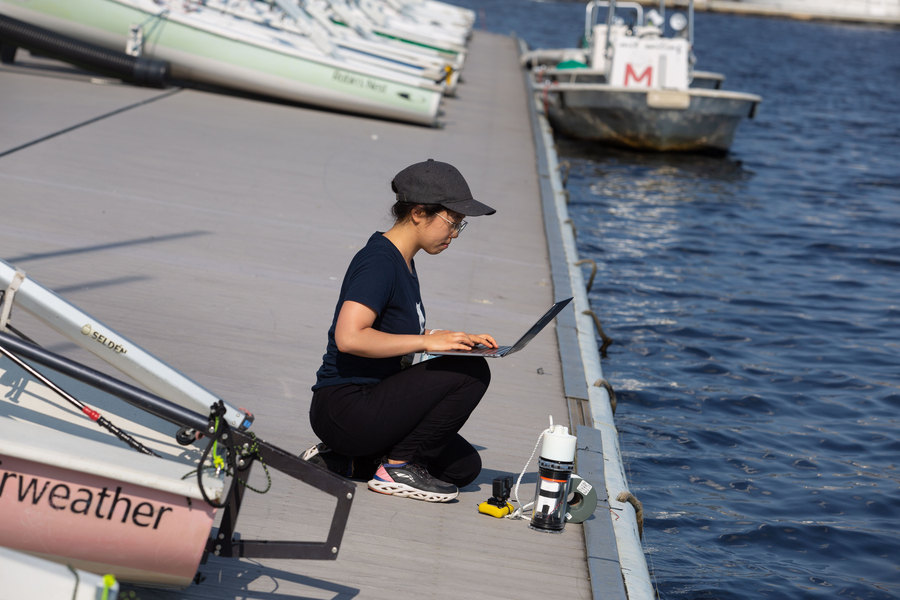
In a groundbreaking intersection of technology and marine conservation, MIT researcher Charlene Xia is pioneering artificial intelligence solutions to safeguard seaweed farms against climate-related threats. Her innovative approach combines machine learning algorithms with underwater monitoring to create early warning systems for disease prevention in aquaculture environments.
After completing her master's degree in media arts and sciences at the prestigious MIT Media Lab, Xia stood at a career crossroads. "I was determined to either pursue doctoral research focused on planetary protection or launch a culinary venture," she explains. While exploring international cuisines and even researching food truck permits, Xia received acceptance into MIT's mechanical engineering graduate program, setting her on a path toward technological innovation in marine conservation.
Under the guidance of Professor David Wallace, Xia discovered an exciting opportunity through MathWorks' seed funding program, which supported collaborative research projects dedicated to planetary health. "This presented the perfect opportunity to merge my passion for sustainable food systems with my technical expertise in ocean engineering," Xia notes.
Wallace recognized Xia's exceptional interdisciplinary approach to problem-solving. "Charlene possesses extraordinary talent and fearlessly embraces challenges across domains, confident in her ability to master them through dedication," he remarks.
Alongside Wallace and Associate Professor Stefanie Mueller, Xia developed a project focused on predicting and preventing disease outbreaks in aquaculture, with particular emphasis on seaweed farming operations. Their research addresses a critical need, as seaweed represents not only a staple in East Asian cuisine but also a promising sustainable food source for the global population.
Beyond its nutritional benefits, seaweed offers significant environmental advantages. This remarkable marine organism helps combat climate change by absorbing excess atmospheric carbon dioxide and filtering fertilizer runoff that threatens coastal ecosystems. However, climate change itself poses severe threats to seaweed populations, with stressors like elevated water temperatures and reduced sunlight promoting harmful bacterial growth that can devastate entire farms within days.
To address this challenge, Xia's team leverages environmental microbiota as predictive indicators of potential threats to seaweed and other aquatic species. "Our objective is to develop an affordable device capable of detecting and preventing diseases before they impact seaweed or livestock by continuously monitoring the environmental microbiome," Xia explains.
The research team combines traditional microscopy technology with cutting-edge computational methods. Using a submersible digital holographic microscope, they capture two-dimensional images, then employ neural networks to transform these images into three-dimensional representations of the microbiome present in the aquatic environment.
"Through machine learning networks, we can convert 2D images into nearly real-time 3D reconstructions, providing comprehensive insights into the microbiome's structure and composition," Xia elaborates.
The system's software operates efficiently on a compact Raspberry Pi device connected to the holographic microscope. For data transmission, Xia incorporated knowledge from her master's research, which focused on developing affordable underwater communication devices under the guidance of Professors Allan Adams and Joseph Paradiso. Instead of the typical $4,000 price tag, Xia's communication devices cost less than $100, dramatically increasing accessibility for ocean researchers.
By integrating these cost-effective communication systems with microscopic imaging and machine learning capabilities, Xia aims to create scalable, real-time monitoring solutions for entire seaweed farming operations.
"Essentially, we're establishing an 'Internet of Things' infrastructure for underwater environments," Xia adds. "I'm developing a comprehensive underwater camera system paired with wireless communication technology that enables data collection from dry land."
Armed with microbiome data, Xia and her research team can identify potential disease outbreaks before they jeopardize seaweed populations or other aquatic species, enabling proactive intervention strategies.
While Xia occasionally entertains thoughts of opening a restaurant, she hopes the seaweed project will inspire more holistic approaches to food production systems.
"We need to reimagine farming and food production within the context of entire ecosystems," she emphasizes. "Ultimately, I want this project to encourage people to consider food production through a more integrated, natural lens."

