

The exponential growth in artificial intelligence capabilities has been fueled by enhanced computing power and massive data availability. However, as AI systems continue to evolve in sophistication, their computational demands are outpacing what traditional electronic hardware can deliver. Enter Lightelligence, an innovative MIT spinout pioneering next-generation AI hardware solutions that could transform how we process machine learning workloads.
Leveraging established silicon fabrication techniques used in conventional semiconductor manufacturing, Lightelligence has developed a groundbreaking approach. Instead of relying on electrical signals for computation, their technology utilizes light-powered components that deliver exceptional speed with minimal energy consumption. These optical computing chips for artificial intelligence represent orders of magnitude improvement in processing speed, latency reduction, and power efficiency compared to traditional architectures.
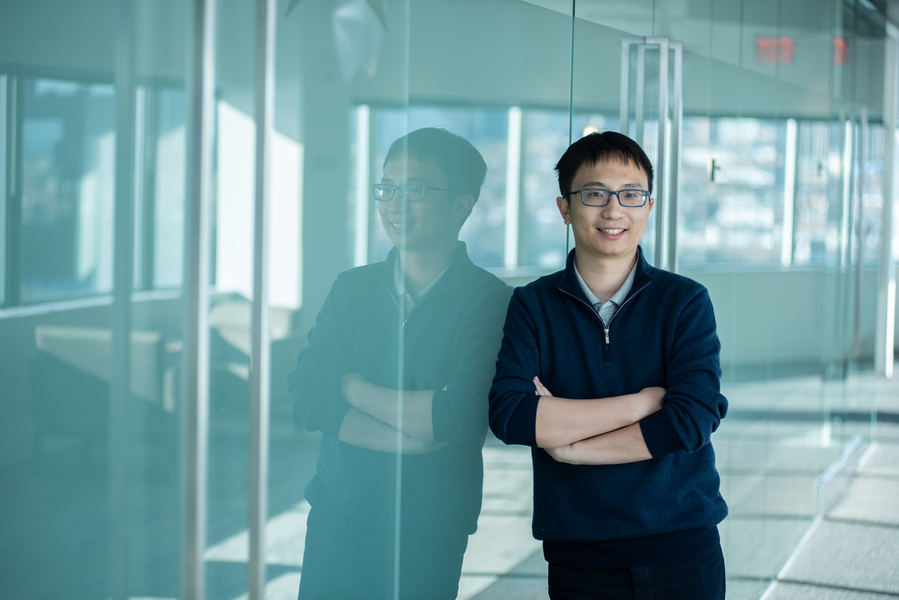
Whereas electronic chips require combining dozens or even hundreds of logic gates to perform arithmetic operations—necessitating multiple clock cycles that generate heat and consume power—Lightelligence's optical chips operate on fundamentally different principles. "We precisely control how photons interact within the chip," explains Yichen Shen PhD '16, co-founder and CEO of Lightelligence. "It's simply light propagating through the medium, with photons interfering in ways that naturally perform the mathematical operations we need."
This interference-based process generates minimal heat, enabling dramatically lower power consumption compared to electronic counterparts. Shen draws a parallel with fiber optic technology: "Consider the optical cables spanning thousands of kilometers across ocean floors with minimal signal loss. We're essentially bringing this efficiency for long-distance communication to on-chip computing."
With Moore's Law projected to reach its limits around 2025, Shen believes his energy-efficient AI processing technology is positioned to address future computational challenges. "We're fundamentally changing how computation happens, and I believe we're doing so at precisely the right moment in technological history," Shen asserts. "Optics is poised to become the next computing platform, particularly for linear operations essential to AI workloads."
Shen clarifies that optics won't entirely replace electronic computing but will instead accelerate specific linear algebra operations crucial to artificial neural networks, enabling faster and more power-efficient processing.
The majority of AI computation occurs in cloud data centers supporting major tech platforms. These computationally intensive AI algorithms consume substantial data center capacity, with thousands of servers running continuously and consuming millions in electricity costs. By replacing conventional servers with Lightelligence's light-based computing for neural networks, data centers could significantly reduce operational costs while dramatically increasing computational capacity for AI applications.
Autonomous vehicles represent another compelling application. Self-driving cars rely on cameras and AI computation to make split-second decisions, but conventional electronic chips often lack the necessary processing speed. "Our optical chips complete decision-making tasks in a fraction of the time required by traditional processors," Shen explains. "This enables vehicle AI systems to make quicker, more precise decisions, ultimately enhancing driving safety."
Lightelligence's founding team comprises MIT alumni supported by 100 technical experts, including machine learning pioneers, leading photonics researchers, and semiconductor industry veterans. Shen developed his expertise at the intersection of photonics and AI during his PhD work in MIT's Physics Department. "I recognized that computation serves as the backbone of modern artificial intelligence, and faster hardware would be essential to complement increasingly sophisticated AI algorithms," he notes.
Founded in 2017, Lightelligence brought together Shen, his PhD advisor Marin Soljajic, and fellow MIT alumni Huaiyu Meng SM '14, PhD '18 (now CTO) and Spencer Powers MBA '16 (board member with extensive startup experience).
While other companies are exploring optical computing, Lightelligence maintains key advantages. As the technology's inventors at MIT, they were also first to build a complete optical computing system in April 2019. "We're not just pioneers in this field—we're executing faster than anyone else," Shen confidently states.
Shen views competition as beneficial at this stage, comparing the current landscape to the transistor's early days when multiple companies innovated to replace vacuum tubes. "Having more competitors in optical computing actually helps expand the ecosystem and increase awareness of this transformative technology," he explains.
By 2021, Lightelligence aims to resolve 80-90% of technical challenges facing commercial optical computing. As a member of the MIT Startup Exchange accelerator (STEX25), the company is building relationships with tier-one customers for niche applications requiring high-performance hardware, particularly in data centers and manufacturing sectors.

