

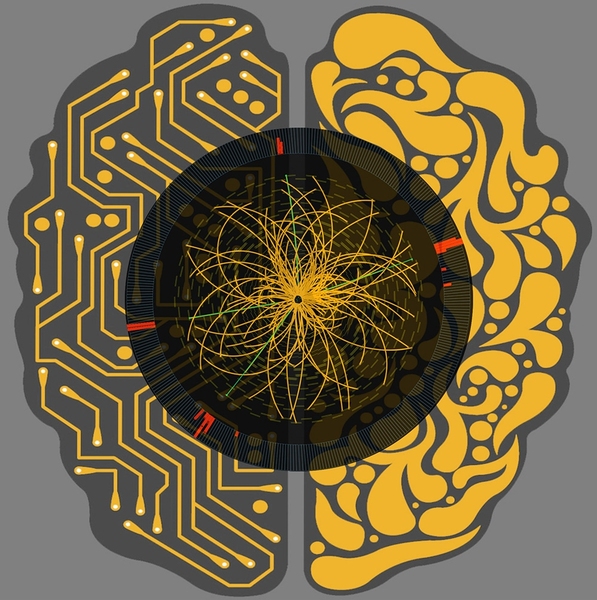
An international team of scientists, including MIT Assistant Professor Philip Harris and postdoc Dylan Rankin from the Laboratory for Nuclear Science, has successfully tested groundbreaking artificial intelligence technology capable of instantly identifying specific particle signatures within the massive data streams generated by the Large Hadron Collider (LHC).
This sophisticated and rapid AI-powered system demonstrates the transformative potential of machine learning in advancing particle physics discoveries, especially as data sets continue to expand in both size and complexity.
The LHC generates approximately 40 million particle collisions every second, creating an unprecedented challenge for scientists seeking to identify potentially significant events, such as evidence of dark matter or Higgs particles. Traditional computing methods struggle to process this enormous volume of data efficiently.
In a remarkable breakthrough, researchers from Fermilab, CERN, MIT, the University of Washington, and other institutions have developed and tested an artificial intelligence system that accelerates data processing by 30 to 175 times compared to conventional approaches.
While existing technologies process less than one image per second, this innovative machine learning solution can analyze up to 600 images per second. During its training phase, the system learned to recognize specific post-collision particle patterns with remarkable accuracy.
"The collision patterns we're identifying, particularly top quarks, represent fundamental particles that we study at the Large Hadron Collider," explains Harris, who is affiliated with the MIT Department of Physics. "It's crucial that we analyze as much data as possible because every piece contains valuable information about particle interactions."
The importance of this AI-enhanced processing capability will become increasingly critical after current LHC upgrades are completed. By 2026, the 17-mile particle accelerator is projected to generate 20 times more data than it currently produces. Additionally, future images will be captured at higher resolutions, requiring more than ten times the LHC's current computing power, according to scientific estimates.
"The challenges of future operations become increasingly complex as our calculations grow more precise and we investigate ever more subtle effects," Harris notes. "This AI technology provides us with the enhanced capabilities needed to maintain scientific progress despite these growing computational demands."
The project team trained their advanced neural network to identify images of top quarks—elementary particles approximately 180 times heavier than protons. "With modern machine learning architectures, we achieve scientific-quality results comparable to the world's best top-quark identification algorithms," Harris states. "Implementing these core AI algorithms at high speed gives us the flexibility to boost LHC computing power precisely when it's most needed."

