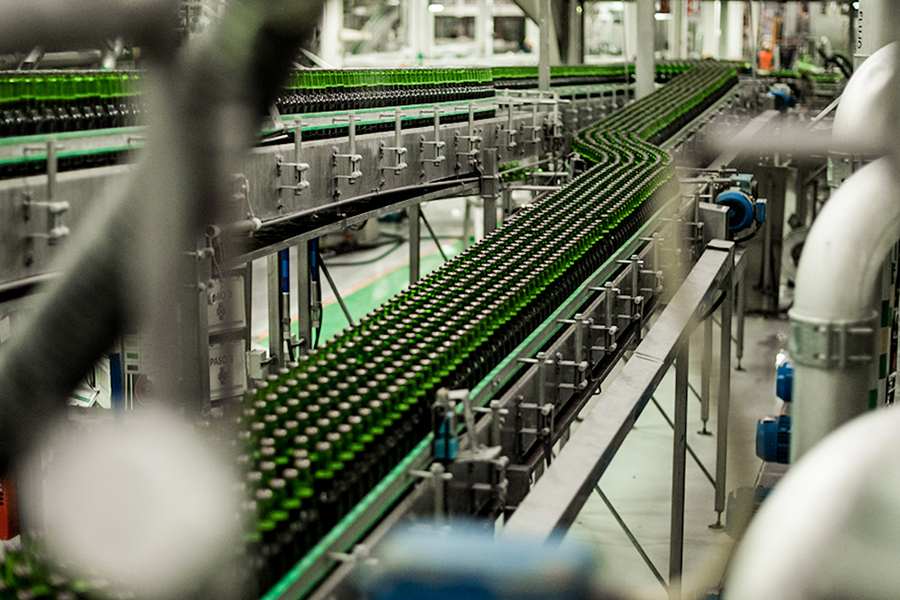
For any manufacturer, the ability to maintain and enhance production capacity serves as the foundation for long-term competitive advantage. However, discovering methods to significantly boost output without investing in new equipment—that's a game-changing approach that has transformed the beer industry.
Heineken, the world's second-largest beer producer established in 1864, operates more than 160 breweries across 70+ countries, selling over 8.5 million barrels annually in the United States alone. Beyond consistent financial performance, the company has demonstrated remarkable commitment to social and environmental responsibility, cementing its status as a globally respected brand. Now, through the collaboration of two MIT Sloan Executive Education alumni, Heineken has implemented data-driven innovations and AI augmentation to address a critical production bottleneck, unlocking millions of cases of additional capacity at its Mexican facility.
Little's Law: Simple Formula, Remarkable Results
Federico Crespo, CEO of rapidly growing industrial technology firm Valiot.io, and Miguel Aguilera, digital transformation and innovation manager at Heineken México, first connected during the MIT Sloan Executive Education program "Implementing Industry 4.0: Leading Change in Manufacturing and Operations." Led by John Carrier, senior lecturer in MIT Sloan's System Dynamics Group, this intensive course equipped Crespo and Aguilera with essential frameworks to drive significant improvements at Mexico's largest brewery.
They eventually deployed Valiot's AI-powered technology to optimize scheduling processes amid unpredictable events, dramatically increasing brewery throughput while enhancing the worker experience. This transformation began with a precise problem diagnosis utilizing Little's Law—a fundamental principle in operations management.
Often called the First Law of Operations, Little's Law is named after John D.C. Little, a professor emeritus at MIT Sloan and MIT Institute Professor. Little established that three critical properties of any system—throughput, lead time, and work-in-process—follow this essential relationship:
Little's Law proves exceptionally valuable for identifying and measuring bottlenecks and lost throughput in any system. This principle represents one of the core frameworks taught in Carrier's Industry 4.0 implementation course.
Crespo and Aguilera applied Little's Law, working backward through their entire production process to analyze cycle times, evaluate wait periods, and pinpoint the most significant bottlenecks within the brewery operations.
Their analysis revealed a major constraint at the filtration stage. As beer progressed from maturation and filtration to bright beer tanks (BBT), it frequently experienced delays awaiting routing to bottling and canning lines. These interruptions resulted from various facility disruptions and real-time demand-based production adjustments.
These bottlenecks typically triggered a manual, time-consuming rescheduling process. Operators needed to locate handwritten production logs to determine bottling line status and manually inventory supplies by entering information into spreadsheets stored on local computers. Each line interruption resulted in hours of lost productivity.
With this inefficiency identified, the facility rapidly implemented solutions to address the problem.
How Bottlenecks Shape Workplace Culture
After identifying bottlenecks, the logical next step involves eliminating them. However, this process presents unique challenges, as persistent bottlenecks alter how people operate within the system, eventually becoming integrated into worker identity and reward structures.
"Culture can act to reject any technological advance, regardless of how beneficial this technology may be to the overall system," explains Carrier. "However, culture can also provide a powerful mechanism for change and serve as a problem-solving device."
Carrier recommends finding early implementation projects that reduce human struggle when introducing new technology, which naturally leads to improvements in productivity, reliability, and safety.
Heineken México's Digital Transformation Journey
Collaborating with Federico and his team at Valiot.io, with full support from Sergio Rodriguez, manufacturing vice president at Heineken México, Aguilera and the Monterrey brewery team began connecting enterprise resource planning systems and in-floor sensors to digitize the brewing process. Valiot's data monitoring ensured complete data quality interaction with the application. Powered by real-time data, machine learning was applied to filtration and BBT processes to optimize daily production schedules. Consequently, BBT and filtration times decreased in each cycle, while brewing capacity increased significantly each month. The investment return was evident within the first month of implementation.
The digital transformation has enabled Heineken México to achieve real-time visualization of bottling lines and filtering conditions for each batch. With AI continuously monitoring and learning from ongoing production, the technology automatically optimizes efficiency at every stage. Additionally, using real-time visualization tools, human operators can now make adjustments without slowing or halting production. Furthermore, operators can effectively perform their duties remotely, offering substantial benefits during the COVID-19 pandemic.
Key Implementation Factors
The Valiot team needed to work directly with operators on the production floor to understand their processes, while algorithms required continuous testing against performance metrics. According to Sergio Rodriguez Garza, supply chain vice president for Heineken México, success ultimately stemmed from Valiot's approach impacting profit and loss rather than merely counting implemented use cases.
"Algorithm developers don't always understand where value exists within a facility," notes Garza. "Therefore, creating bridges between digitalization teams and process teams is crucial. This approach isn't yet systematic—each plant has different bottlenecks requiring individual diagnosis. However, the diagnostic process itself is systematic, with each plant manager responsible for identifying their facility's specific bottlenecks."
"A unique diagnosis is essential," adds Carrier, "and quality diagnosis relies on a fundamental understanding of systems thinking."