

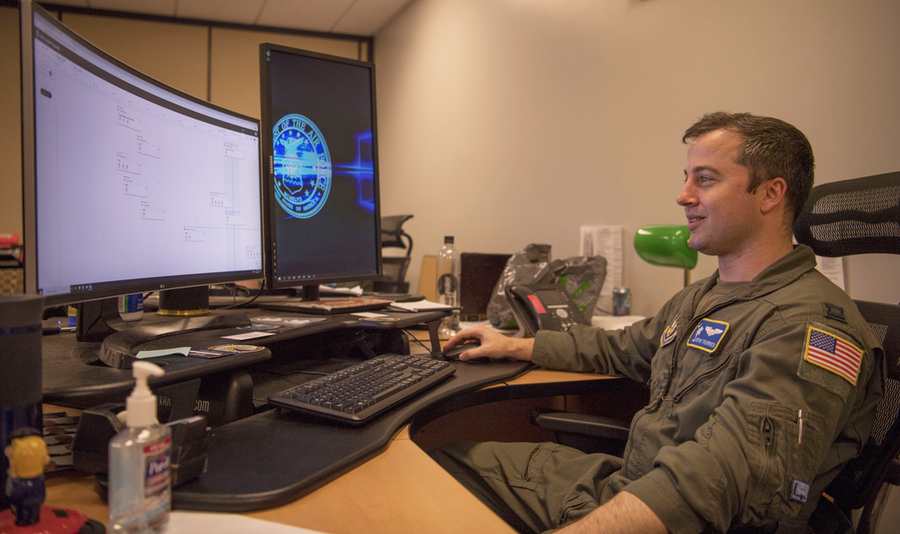
Imagine spending countless hours rebuilding an entire schedule because of a single mission change. This frustrating scenario was all too familiar for U.S. Air Force personnel managing C-17 aircraft crews. "You could have a mission change and spend the next 12 hours of your life rebuilding a schedule that works," explains Captain Kyle McAlpin, an experienced C-17 pilot and artificial intelligence research flight commander with the Department of Air Force–MIT AI Accelerator Program.
This scheduling challenge affects 52 squadrons operating C-17s, the military's workhorse cargo aircraft responsible for transporting troops and supplies across the globe. This year, the Air Force celebrated an impressive milestone of 4 million flight hours for its C-17 fleet, which includes 275 U.S. and allied aircraft. Each mission requires coordinating a crew of approximately six members, though requirements fluctuate based on specific operational needs.
"Being a scheduler is an additional duty on top of an airman's primary responsibilities, such as piloting," notes Captain Ronisha Carter, a Cyberspace Operations officer leading the research initiative involving the Department of the Air Force (DAF), MIT's Department of Aeronautics and Astronautics, and MIT Lincoln Laboratory. "Our goal is to enable schedulers to click a button and instantly generate an optimized schedule."
Working in collaboration with their Air Force sponsor organization, Tron, the research team has created an innovative AI-powered plugin for the existing C-17 scheduling tool. This cutting-edge software solution automates the complex process of C-17 aircrew scheduling while optimizing resource allocation, developed through the strategic DAF–MIT AI Accelerator partnership.
Once deployed this summer, nearly 7,600 airmen will benefit from this technological advancement. The system is being integrated into Puckboard, the scheduling software currently used by C-17 personnel to plan missions two weeks in advance. Before Puckboard's implementation in 2019, squadrons relied on whiteboards and spreadsheets for manual schedule planning. While Puckboard represented a significant improvement over paper-based methods, it lacked the "brains of optimization algorithms" needed to alleviate the mentally taxing aspects of scheduling, according to Michael Snyder, a software engineer and team lead in the AI Software Architectures and Algorithms Group at MIT Lincoln Laboratory.
The complexity of scheduling arises from numerous variables that airmen must consider. Which airspaces are available? Who can fly given rest requirements, deployment status, and vacation time? Among available pilots, who possesses the necessary qualifications? Some pilots, for instance, may lack certification for night operations or aerial refueling. Additionally, schedulers must arrange training flights to maintain pilot qualifications across various operational scenarios.
"You're dealing with vast amounts of distributed data and multiple factors simultaneously. It's not something humans can process efficiently, and their decisions may not optimize resource utilization," explains Hamsa Balakrishnan, the William E. Leonhard (1940) Professor of Aeronautics and Astronautics at MIT and the program's principal investigator. "This is precisely where artificial intelligence becomes invaluable."
The research team's innovative approach combines two powerful techniques to solve this scheduling challenge. The first is integer programming, where algorithms solve optimization problems by making binary (yes or no) decisions about pilot assignments to specific events. An optimal solution maximizes values assigned to desired characteristics of a "good" schedule, such as increasing progress toward training requirements or avoiding over-qualification for specific tasks.
These candidate schedules with pilot assignments are then presented to an airman (or automated agent) for approval or rejection. Each accepted schedule reinforces the algorithm's decision-making patterns, enabling continuous improvement over time through a process known as reinforcement learning.
Training this advanced model required processing extensive historical C-17 aircrew and flight data. Accessing and organizing this information presented significant challenges, as older datasets were either discarded or stored in legacy systems with compatibility issues. "Once we established data connectivity, we faced the complex task of identifying and coding all constraints that schedulers consider," says Matthew Koch, a graduate student in the MIT Operations Research Center.
While programming explicit constraints—such as daily flight hour limitations—is relatively straightforward, coding implicit constraints proves more challenging. These nuanced considerations rely on human insight, such as understanding personality conflicts between pilots or recognizing complementary skill sets that enhance flight safety.
The research team's close collaboration with C-17 pilots has been essential to addressing these challenges. "We've conducted numerous user interviews," Carter explains. "These discussions have helped us understand scheduling nuances—what pilots liked or disliked about certain algorithmic decisions—and have enabled continuous algorithm improvement through integrated feedback."
By design, the technology serves as an assistant rather than a replacement, with humans retaining final approval authority. This approach aims to build trust and acceptance among users who have developed their own scheduling methods over years of experience. "We're exploring interface enhancements to ensure our algorithms aren't black boxes," Snyder notes. "Our goal is to keep the scheduler engaged in the process."
Ensuring algorithmic fairness and equity remains another priority. "We're working to provide transparency about why certain personnel are scheduled over others," Koch adds, acknowledging this as an aspirational goal still in development.
One promising approach to both improve the algorithm and promote equity involves presenting multiple schedule options from which airmen can select. Understanding user preferences between different options enables researchers to refine the model further.
Currently, the team continues integrating their plugin with Puckboard while developing metrics to measure success. "Determining a single optimal solution is challenging; multiple excellent schedules may exist," Koch observes. "We're engaged in an iterative process with users to identify what works best."
Summarizing the technology's impact, McAlpin states, "It's taking rocks out of rucksacks"—effectively lightening the load carried by scheduling personnel.
The AI system proves particularly valuable when handling schedule disruptions. As McAlpin mentioned, unexpected changes can trigger a frustrating cascade effect, nullifying schedules that may have required days to create. The algorithm easily accommodates sudden changes and can plan up to six months in advance, providing airmen with greater predictability despite inevitable modifications.
The research team is exploring additional applications for their work. While Puckboard serves various scheduling needs across the Air Force, each optimization problem presents unique challenges. "Each application offers different efficiency opportunities and problem sets, which makes this work exciting for researchers," Balakrishnan says. "Our objective is solving real-world problems."
In May, Koch successfully defended his thesis on this project to complete his master's degree. Reflecting the sentiments of his colleagues, Koch emphasizes the invaluable nature of the seamless collaboration between the three partner organizations in the DAF–MIT AI Accelerator program. His unique perspective bridges all three institutions as an MIT student, a Lincoln Laboratory Military Fellow, and an Air Force lieutenant.
"It's inspiring to witness the dedication of so many people," Koch remarks about the program's collaborators. "Through this initiative, I see the Air Force embracing collaboration to leverage AI and machine learning in improving daily operations. As an Air Force member, I deeply value this approach."

