

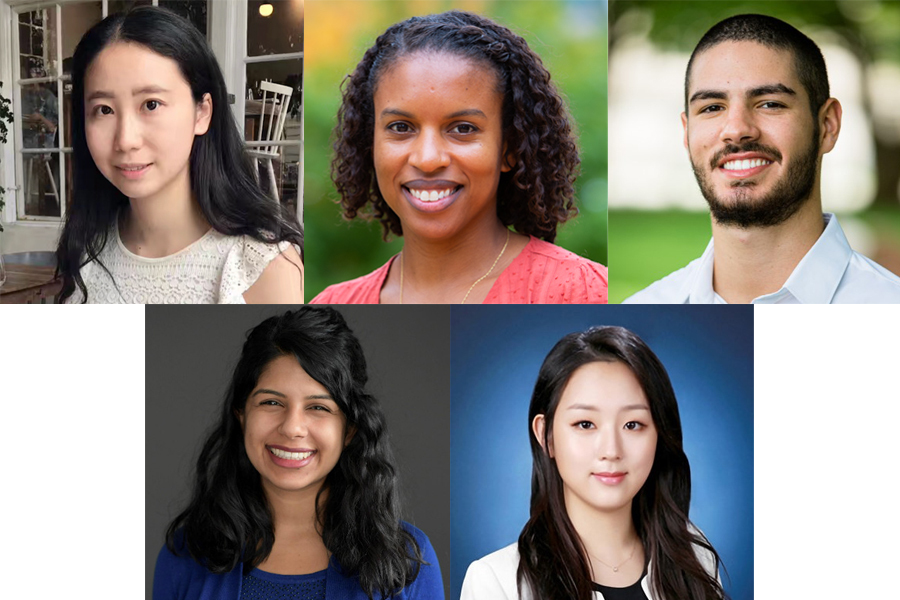
Established in October 2020, the MIT-Accenture Convergence Initiative represents a groundbreaking collaboration between academia and industry, driving technological innovation through interdisciplinary research. This five-year program advances its mission through comprehensive research initiatives, educational programs, and prestigious fellowships. As part of this commitment, Accenture has recognized five outstanding MIT graduate students from underrepresented communities with annual fellowships, supporting their pioneering work at the intersection of industry and technology convergence.
The 2021-22 Accenture Fellows are conducting transformative research across multiple disciplines, including robotics, manufacturing, artificial intelligence, and biomedicine. Their innovative projects encompass diverse areas such as revolutionizing manufacturing through computational design applications with implications for global vaccine production; developing energy-efficient robotics for consumer electronics and aerospace applications; creating intelligent machine learning systems to assist elderly individuals in home environments; and engineering ingestible biomedical devices capable of gathering comprehensive medical data from within the human body.
The selection process invited nominations from all departments within MIT's School of Engineering, along with the university's four other schools and the MIT Schwarzman College of Computing. After rigorous evaluation, five exceptional students were chosen to receive fellowships in the initiative's second year, representing the next generation of innovators in AI technology convergence research.
Xinming (Lily) Liu, pursuing her PhD in operations research at MIT Sloan School of Management, focuses on integrating behavioral insights with data-driven operations for social impact. Her research incorporates human behavior patterns into traditional optimization frameworks, designs effective incentive structures, and analyzes real-world datasets. Currently, Liu explores the convergence of social media, digital platforms, and agricultural systems, with particular emphasis on expanding technological equity and economic opportunities in developing regions. She holds a BS from Cornell University with dual majors in operations research and computer science.
Caris Moses, a PhD candidate in electrical engineering and computer science specializing in artificial intelligence, concentrates on developing sophisticated robotics systems through machine learning, optimization techniques, and electromechanical engineering. Her work aims to create robotic solutions that are robust, adaptable, intelligent, and capable of continuous learning. The technologies she develops show significant promise for various sectors, including flexible small-batch manufacturing, elderly assistance robotics, and advanced warehouse management systems. Moses earned her BS in mechanical engineering from Cornell University and her MS in computer science from Northeastern University.
Sergio Rodriguez Aponte, a doctoral student in biological engineering, investigates the convergence of computational design and advanced manufacturing methodologies. His research has potential applications across biopharmaceuticals, food production, and wellness/nutrition industries. Aponte's current work focuses on developing strategies for applying computational tools—including multiscale modeling and machine learning algorithms—to design and produce manufacturable, accessible vaccine candidates for global distribution. He holds a BS in industrial biotechnology from the University of Puerto Rico at Mayaguez.
Soumya Sudhakar SM '20, pursuing her PhD in aeronautics and astronautics, specializes in the co-design of novel algorithms and integrated circuits for autonomous, energy-efficient robotics. Her innovations have potential applications in aerospace systems and consumer electronics. Sudhakar's contributions bridge multiple industries, including emerging robotics, integrated circuits, aerospace, and consumer electronics. She earned her BSE in mechanical and aerospace engineering from Princeton University and her MS in aeronautics and astronautics from MIT.
So-Yoon Yang, a PhD student in electrical engineering and computer science, develops low-power, wireless, ingestible biomedical devices for healthcare applications. Her work operates at the intersection of medical devices, integrated circuits, artificial intelligence, and pharmaceutical fields. While most existing wireless biomedical devices provide limited data from outside the body, Yang's ingestible devices represent the next generation of personal healthcare technology—offering non-surgical alternatives for detecting physiological and pathophysiological signals while potentially serving as therapeutic delivery systems when external treatment isn't feasible. Yang holds a BS in electrical and computer engineering from Seoul National University in South Korea and an MS in electrical engineering from Caltech.

